


Hey, Luca here! Welcome to a ✨ monthly free essay ✨ from Refactoring.
Every week I write an article to 170K+ engineers about how to make good software together. To get access to all our articles, resources, and our private community, subscribe to the full version below:
Hey there! Welcome to a new edition of my monthly updates on my AI coding workflow.
Once a month I publish an article about how I develop Tolaria, including an overall recap plus the latest updates, and some useful resources. I only ship these when there is something real to say, so you will not get the same post every month just with a different date on top!
I consider part of my work (combined between Tolaria & Refactoring) to always try the latest and greatest, so you will only get thoughts that come from real usage and experiments.
So here is the agenda for today:
🔄 Workflow recap — for those who missed the previous episodes.
💧 Tolaria updates — product updates from this month, and what’s coming next.
☁️ Agents move to the cloud — a general trend plus my personal experience of gradually moving away from my Mac Mini (and my laptop).
🤖 Moving to Grok Bot — from a single local orchestrator agent to a panel of five, hosted in the cloud.
➡️ What’s next — what I am excited to improve for next time.
Let’s dive in!
🔄 Workflow recap
For those who missed the previous episodes, here are some pointers:
Product management — how I do traffic control between issues, PRs, and product requests, and orchestrate the overall product backlog.
AI Coding — my own approach to scaling coding with agents, via guides, gates, and guards. Mostly remained unchanged from last month.
Tools I use — deeper dive into how I use the tools from the alliance, and others too.
Summer AI Coding Updates — last month’s edition (forking our editor, custom performance gates, and notes about the latest GPT models).
Also, this series (and the whole development of Tolaria) is made possible by the great tools I use everyday, that also sponsor the project, which are:
1) CodeScene 🔬
It guarantees great code health across the codebase. My coding agent uses their CodeHealth MCP as a guardrail, enforcing 10/10 health. I have been using it from day one of Tolaria — very recommended!
2) Codacy / Verity 🔒
It’s quality & security as gates: an all-in-one PR reviewer. Codacy also launched Verity (beta), which helps Claude Code fix quality, security and intent issues on every run, and builds a knowledge base of decisions to make every session smarter than the last. That’s basically what I have been doing manually with ADRs, so I am excited to see where this is going!
3) Unblocked 📑
I use Unblocked as context engine, both for my coding agent to use, and for me to ask questions to. I am also testing their latest Unblocked Code coding agent as a straightforward way to get small tweaks done.
4) CircleCI 🔧
I use CircleCI to run local validation remotely, via their chunk sidecars, and I am also migrating the whole remote CI to it. I love their focus on speed and reliability, which is important to me in order for validation not to become too big of a bottleneck for the coding agents.
Now on to the new stuff, but first... product updates. Because my workflow is only as good as what I ship with it 👇
💧 Tolaria updates
This month for Tolaria is lighter on new features and heavier on two bets that I am still working on. These are the mobile apps and a hosted version of Tolaria. These are also two of the things people are asking the most for (mobile is #1 far and away), so I’ll give some updates.
1) Mobile
By now I have a working iPad prototype already, with the UI rebuilt in React Native. It’s a universal app, so it also works on Android tablets (at least in the simulator, because I don’t have one to try it on).
I started with the tablet first for two reasons: 1) the UI is easier to map almost 1:1, and 2) selfishly, I do a lot of work from my iPad so I need an iPad version of Tolaria.
What’s still missing/unfinished are mainly the Git and AI integrations, with Git being particularly tricky (will elaborate on it over the next few weeks!)
Once the tablet version is ready, though, the smartphone version is quite straightforward. The UI will be simplified a bit, but technically speaking it’s not a big deal.
2) Hosted Tolaria (exploration)
I am also thinking about releasing a web version of Tolaria, that is self-hostable but also available with a managed option, so the vault is reachable without the need for a local native app.
This would be good for many reasons:
Makes sharing files easier, opening up to web sharing a-la Google Docs
Obviously makes vaults accessible from anywhere (also reducing the need for mobile native apps)
Could turn into a side business model for Tolaria, with the managed version being a paid option.
About the third point: Tolaria is run and developed as a sidekick to our Refactoring business, and we also have good sponsors (thank you ❤️) so I am under zero pressure to profit further from it, but a hosted version 1) could be genuinely useful for some people (they asked for it) and 2) of course it would cost money to run, so it should be paid.
This is still in exploration stage, so I am happy to hear your thoughts and ideas about it!
☁️ Agents move to the cloud
By now, I think we have all seen the half-open laptop meme. As you can see in my previous posts, for a long time, I have run all my product development on my machines, and in particular:
Orchestration via OpenClaw first, and Hermes later.
Coding via Codex instances on my Mac Mini, and occasionally on my Macbook.
I believe that as 1) we understand better what agents need, and 2) agents themselves become more capable and can use computers more broadly, we are necessarily going to move away from local environments and increasingly ship these in cloud VMs, at least for agents doing actual work.
In a way, this is the same thing that happened with regular applications. We are not hosting websites and apps in our basement anymore (at least not the majority of us?!) — we are using the cloud for that. Cattle vs pets, and all that jazz.
I believe the same will happen with AI agents, because the benefits are just overwhelming. I don’t think local agents will disappear, because it will always be good to run a good agent on the computer you actually use, but when it comes to deploying many of these boys, there’s no way we’ll be doing these on our machines. So most of the agentic work will turn to the cloud.
For me, this migration had already started slowly, with experiments here and there, but got a decisive acceleration when I tried Grok Bot this month.
Grok Bot has been a revelation because of how well-made, convenient, and useful it is, and I migrated all my agent work (except coding) to it.
If you are unfamiliar with it, Grok Bot is an agent environment built by the team at Cursor, where you can spin new agents that are automatically hosted in the cloud, on Linux VMs. On their machines, the agents can do anything they want: install stuff, use tools, use their browser, and so on. Mind you, this is nothing inherent new or that you couldn’t setup yourself, but it’s just 100x more convenient than setting things up manually with SSH, Tailscale, Termius, containers, and so on.
So, once you try it, it’s pretty obvious all agent environments should work this way — and I bet they will. Because having agents hosted in the cloud makes them replicable, disposable, makes it easy to run many of them concurrently, gives you good mobile access out of the box, and a loong tail of quality of life improvements.
So here is how Grok Bot changed my agents setup:
🍻 From Brian to... Brian & Friends
If you followed the previous episodes, you know that I have been running just one main agent, as a second version of myself, for all the orchestration work that is not coding. It’s called Brian, and it’s my “Chief of Staff”.
Over time, Brian clearly started doing too many things, taking care of: product work for Tolaria, all kinds of work for Refactoring, and various scheduling and traffic control for my own life.
Grok Bot allowed me to easily spin off Brian’s work into multiple agents, so that now I have five of them:
1) Brian
Stays as Chief of Staff.
He is the default agent I reach out to for anything misc, and is on top of everything that happens that I need to be aware of.
Every morning he sends me a brief about what I need to take care of during the day, writes me a recap at the end of the day, and occasionally sends stuff my way during the day when something urgent needs my attention.
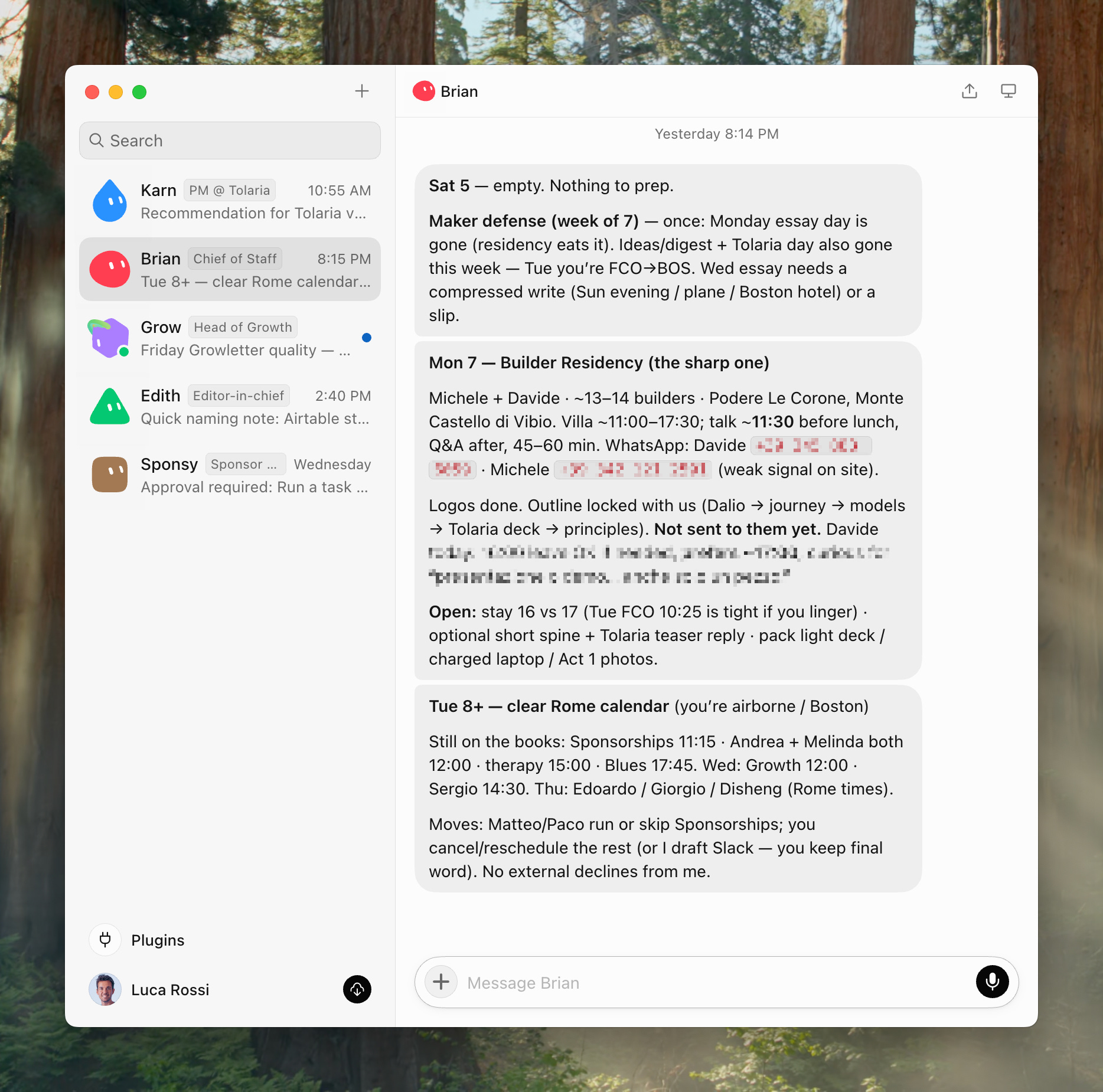
Now, however, he is also being helped by his friends 👇
2) Karn
Runs product management for Tolaria.
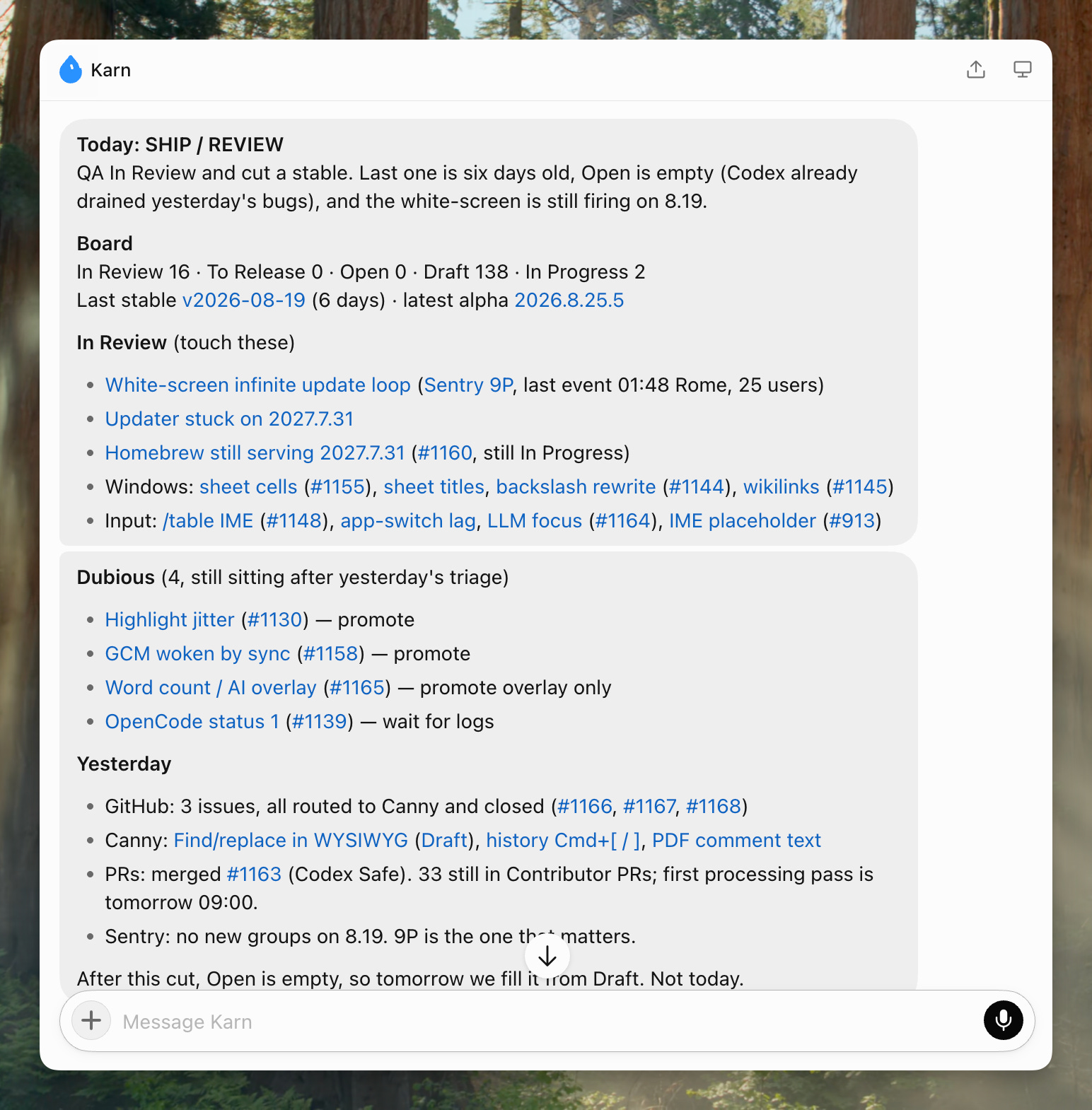
It has access to all the product signal that comes from PostHog, Sentry, Github, Canny, emails I receive about Tolaria, and people talking about it on social media. Like Brian before it, it does traffic control, triages and dedupes items, specs them, and puts them on the coding kanban board.
He also sends me a brief every day with the key decisions I need to make about Tolaria, including tasks I need to review 👇
3) Edith
Is my Editor-in-Chief.
While I insist on writing all actual articles by hand, Edith intervenes at the beginning and at the end of the process, by doing:
Research — for any new article, it pulls related ideas from past articles I wrote, interesting new articles I should read, podcast interviews, and more. It is phenomenally helpful in compressing and improving the research work.
Feedback — after I write a full draft, it gives feedback on everything from basic grammar to inconsistencies in the structure, contradictions, and so on. It is good at challenging what I write so I can reflect more on it.
It is also “in charge” of the newsletter publishing calendar, so it makes sure the various drafts are ready at the right time, podcast interviews are lined up, articles done in collaboration with others are shared in advance, and so on.
4) Sponsy
Helps with Sponsorships.
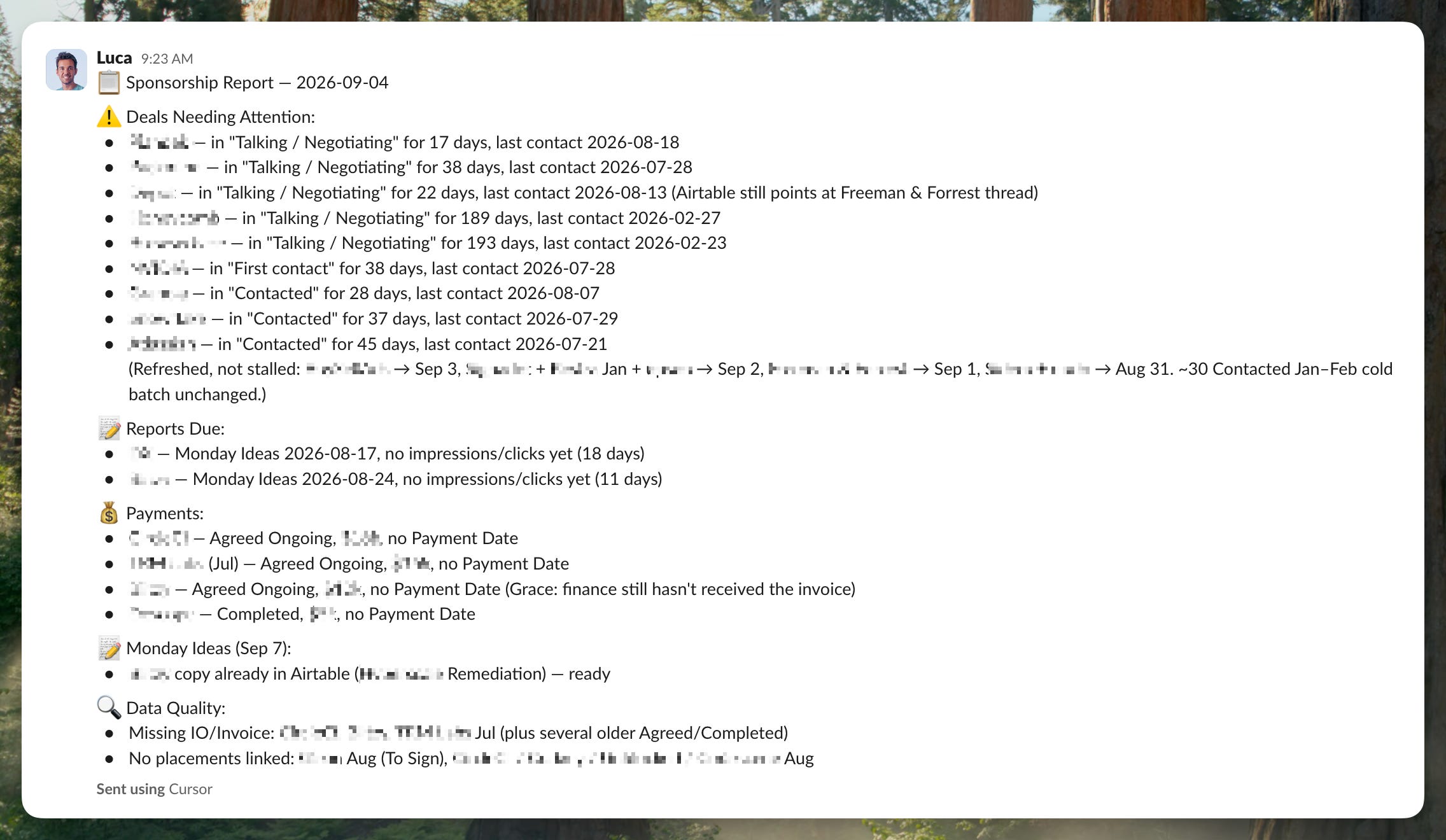
At Refactoring, sponsorships are led by Matteo, my closest collaborator, and they involve a ton of operations. Sponsorships deals have a whole lifecycle, like standard sales deals, plus they spawn tasks that are specific to the newsletter work, like:
Collecting the copy to include in the newsletter
Sending previews
Reporting numbers after ~1 week
and more!
Sponsy helps a lot with mapping the status of the various deals, what needs to happen every day.
5) Grow
Grow is the newest addition to the bot stack (or should I say team?!). It tracks a bunch of metrics for the newsletter health (open rate, growth, click rate, ...) and helps with operations related to the paid ads campaigns we run.
In particular, it does a lot of work that would otherwise be manual: for example, importing new subscribers from campaigns into Substack, and assigning the correct tags to them so we can create email sequences.
It also sends daily reports about how campaigns are going, like:
Closed week: 163 Substack Meta regs (vs 203 prior, −40 / −20%). Received-mail unique 7d open 40.0% (60/150) vs 44.8% prior (−4.8pp). Morning was 36.1%; afternoon refresh after more people received mail (raw 60/163; 13 not received yet). Paid converts: 2 (vs 3 prior).
🔭 What’s next
This setup is about one month old and is by no means perfect, but it just shows how much promise there is in creating fleets of small-scoped agents to scale work.
To make this viable, though, it needs to be easy to create and steer these guys, which I think is what Grok Bot is uniquely succeeding at.
When agents are successful at 1) doing their thing, plus 2) reporting to you, you can legitimately do most of your work in a chat environment, or with voice notes, without using the tools yourself. Which is basically what you see in the GPT 6 Astra launch video.
I think this is a good direction to point ourselves at, as a proxy for good delegation. So, good questions you may ask yourself are:
“How can I use my computer less?“
“How can I do more work from my phone, just sending voice instructions?”
In a way, it’s like when you see pictures of the desk of the President of United States, and there is no computer. How does the guy (ok, the previous guys) get things done? He just talks to people. People come and tell him what needs to happen, what decisions he needs to make, who he needs to speak with, and he does. He doesn’t need tools.
This might be an extreme, but I think you see my point.
📌 Bottom line
And that’s it for today! Here are the main takeaways:
☁️ Most agent work goes to the cloud — local agents won’t disappear on the computer you actually use, but deploying the bulk of them on your Mac Mini (or laptop) stops making sense. Same arc as applications in the cloud.
🤖 Grok Bot made the jump easy — cloud Linux VMs, install what you need, with browser included. I moved all non-coding agent work there because it is just much more convenient than the SSH / Tailscale / Termius stack.
🍻 Team of small agents > One mega agent — work feels better now that I have a small fleet of focused agents instead of Brian doing all of the work.
🔭 Aim at less computer, more chat — when agents do the work and report back, more of your day can live in chat or voice notes. So a proxy for good delegation becomes: how can I use my computer less?
I wish you a great week!
Sincerely 👋
Luca
Smart shift specialized agents beat one monolithic orchestrator. The use computer less framing is the real metric for effective delegation.
Hey @Luca, thanks for this great article (and short - thank you for that - lots of value in 5mn reading is very pleasant !).
You still run your coding agents on your Mac Mini right ?
Do you know of any "simple" stack to - hopefully at some point - easily create a fleet of agents in the cloud ? I have read a bit about Crabbox (from Peter Steinberger), Rivet which also seems promising - but haven't had a chance to set things up yet. I am looking for assembling a bunch of tools to be able to quickly and easily say : "create an agent with these instructions, and here is the cloud based server you can run it into" (like starting with a cheap 5 euros / month VPS, upgrading as it needs to scale)
Maybe it is a question that fits the Community forum better; in that case let me know I will move it there !
Thanks in advance 🙏