Hey, Luca here, welcome to a weekly edition of the💡Monday Ideas💡 from Refactoring! To access all our articles, library, and community, subscribe to the full version:
Aboard is your partner for AI transformation. We use a proprietary AI platform to build software to help you run your business. Our software looks good, uses best practices, is highly secure, and ships in a fraction of the time it used to take.
We aren’t bots—we manage them. We keep people at the center, both our engineers and our clients. AI accelerates development, but humans step in when it matters most: to refine, polish, and launch at production quality.
Your growth matters to us. Spend less time struggling toward software solutions. We’ll save you time and money, and stay nearby whenever you need us.
In most workflows, today, people are using AI to create drafts — drafts of code, drafts of code reviews, drafts of docs — and have humans do a final pass.
This is nice, but it also corners people into doing a lot of context switching and micro tasks.
I believe that sometimes, under controlled conditions, we should take a leap of faith and completely automate some tasks with AI.
We should switch from an “approve first” to a “possibly revert later” approach.
Ask yourself: what are those things that AI can do that would be relatively inexpensive to revert in case it does them wrong? Chances are it’s more than you think.
2) 📱 Fragmentation testing journey
Earlier this year we wrote a thorough guide on mobile fragmentation testing.
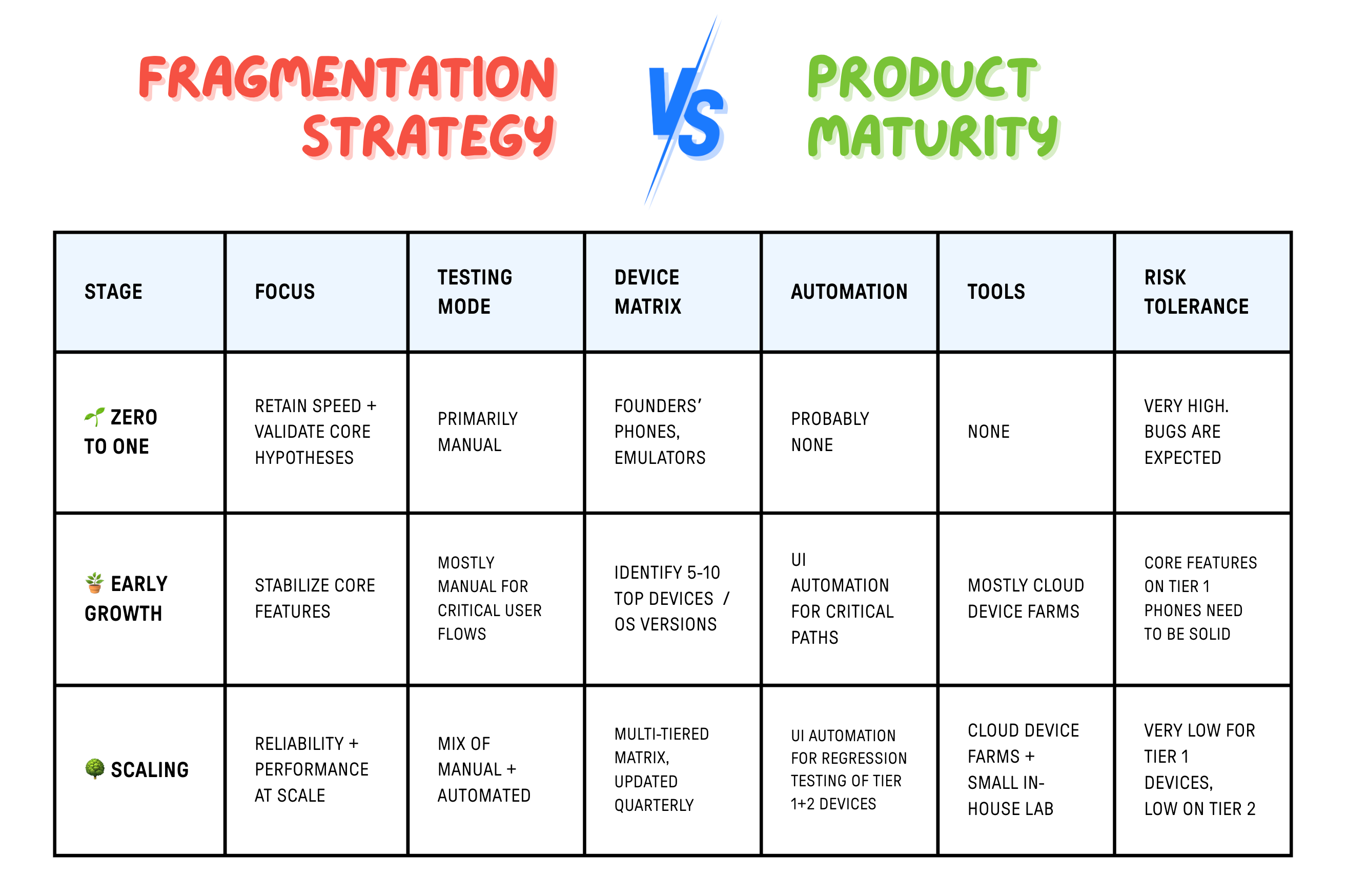
A key theme was that your approach to fragmentation should evolve alongside your product and team journey: applying enterprise-level rigor to a pre-PMF product wastes resources, just as neglecting testing at scale is a recipe for disaster.
We tried to map your fragmentation strategy to each stage, so here is the cheat sheet:
Your device “matrix” is likely just the founders’ phones plus a couple of emulators for basic layout checks. Testing is manual and happy-path only: does the core loop work? Can users sign up? Automation is probably overkill.
Risk tolerance: Very high. The bigger risk is building the wrong product, not having a polished app on every device. Don’t let fragmentation concerns slow you down.
Use analytics to identify your top 5-10 devices and OS versions—this becomes your evolving matrix. Testing is still manual but more structured. Consider automating 1-2 critical paths (e.g. signup, purchase) if you have expertise. Cloud device services become useful for occasional checks on devices you don’t own.
Risk tolerance: Medium. Core functionality on popular devices must be solid.
Scaling / Established Product 🌳
Focus: Reliability, performance at scale, protecting brand reputation.
Maintain a well-defined, multi-tiered matrix updated with fresh analytics. Invest significantly in UI automation for regression testing. Rely heavily on cloud device farms, potentially supplemented by an in-house lab over time.
Risk tolerance: Low for Tier 1 devices, higher for Tier 3.
In May I interviewed Rands, Senior Director of Engineering at Apple and writer of several popular books about engineering management, including “Managing Humans”, which is a personal favorite of mine.
I asked him how engineering management is changing today, and the first thing he noted was how the pace of change dramatically increased. With respect to a decade ago, where management felt more like a timeless skill, today it feels harder for individuals and teams to adapt and learn new playbooks as quickly as tech evolves.
For this reason, Rands now believes engineering leaders should stay deeply connected to tech, reversing his earlier stance that managers should step away from coding.
His preferred org structure, however, remains consistent:
👥 7±3 direct reports — optimal span for providing meaningful human attention to each team member.
📊 Three layers maximum — from CEO to individual contributor for effective communication.
🤝 Small, empowered teams — avoiding the bureaucratic layering that characterizes large tech companies.
“I truly believe that a manager or leader is capable of managing about seven plus or minus three folks... more than that, and you do not have time for humans.”
And speaking about AI, rather than changing what ideal teams look like, Rands believes it’s making already-optimal team structures even more effective.
And that’s it for today! If you are finding this newsletter valuable, subscribe to the full version!
1700+ engineers and managers have joined already, and they receive our flagship weekly long-form articles about how to ship faster and work better together! Learn more about the benefits of the paid plan here.





Combining AI with human oversight is the sweet spot for modern engineering.