


Hey there! Welcome to a new edition of my monthly updates on my AI workflows.
Once a month, I share how I am working with AI, especially to develop Tolaria: an overall recap, the latest updates, and what I learned along the way.
The biggest news of the month for us is not a feature: it’s that, for our small team, AI is finally delivering. I won’t say AGI or what, but as of today our agents have truly lifted the way we work, and I want to tell you everything about how.
Also, if you missed the previous episodes, last month I introduced Tolaria for mobile, and earlier chapters covered how I run the Tolaria project and guides, gates and guards.
So, here is the agenda for today:
🤖 AI is finally delivering — what changed for us, and our org chart of bots and people.
🏢 Every area gets a manager — drafts for everything, chiefs of staff, and area bots.
🛠️ Bots build their own tools — custom software, PM bots, and feedback loops.
🧠 Knowledge should outlive bots — a shared vault, memory and retros.
🖥 Tolaria needs a web version — why the web comes next.
🎮 I am building a game — bonus: making an open world where every NPC is an AI!
Let’s dive in!
Thanks to the Tolaria Alliance! 🙏
But before that, I want to remind you that Tolaria itself stays free and open source thanks to the Tolaria Alliance and the support from the tools I use every day.
I am really happy with these tools: together with the broader harness, they give me close to 100% peace of mind about never looking at the actual code:
CodeScene: keeps code health high across the codebase. It is one of the gates every commit has to pass, and I keep a 10/10 threshold.
Codacy: code quality and security, plus Verity for reviews inside the agent loop against our own ADRs. Verity is our latest addition and is working very well. It catches bad code before it makes it into a PR, matching what Verity’s own benchmarks say: it finds >2x more bugs than PR reviewers.
Unblocked: it helps agents (and me) find context across the codebase, ADRs, Linear, GitHub issues, and commit history. It just works!
CircleCI: our CI, which runs all the gates largely in parallel. We moved to CircleCI from Github, and slashed our CI time from 15 mins to less than 4!
🤖 AI is finally delivering
Last month I wrote about our growing family of Grok Bot assistants, and I said it wasn’t worth going into detail about what each bot does. A month later I changed my mind, because the setup kept scaling, and I believe how the bots work together is now more interesting than any single one of them.
So the short version is: Grok Bot has lifted our (small) org in a way no AI did before. We do more, at a higher level of quality, without increasing the burden on any human on the team. I couldn’t say this about any AI tool before, and now I can: for us, AI is delivering.
As a byproduct of this, we started building a lot of custom software for ourselves: internal tools, Tolaria of course, and... a game (more on that at the end!). All of this is run by three kinds of bots, plus the humans:
📣 Chiefs of Staff — everyone on the team has one.
💂 Area Managers — one bot for every business area that deserves continuous work.
🎨 Product Managers — who own the software we build.
🙋♂️ Human Owners — Paco, Matteo, Melinda and me, who own the respective areas.
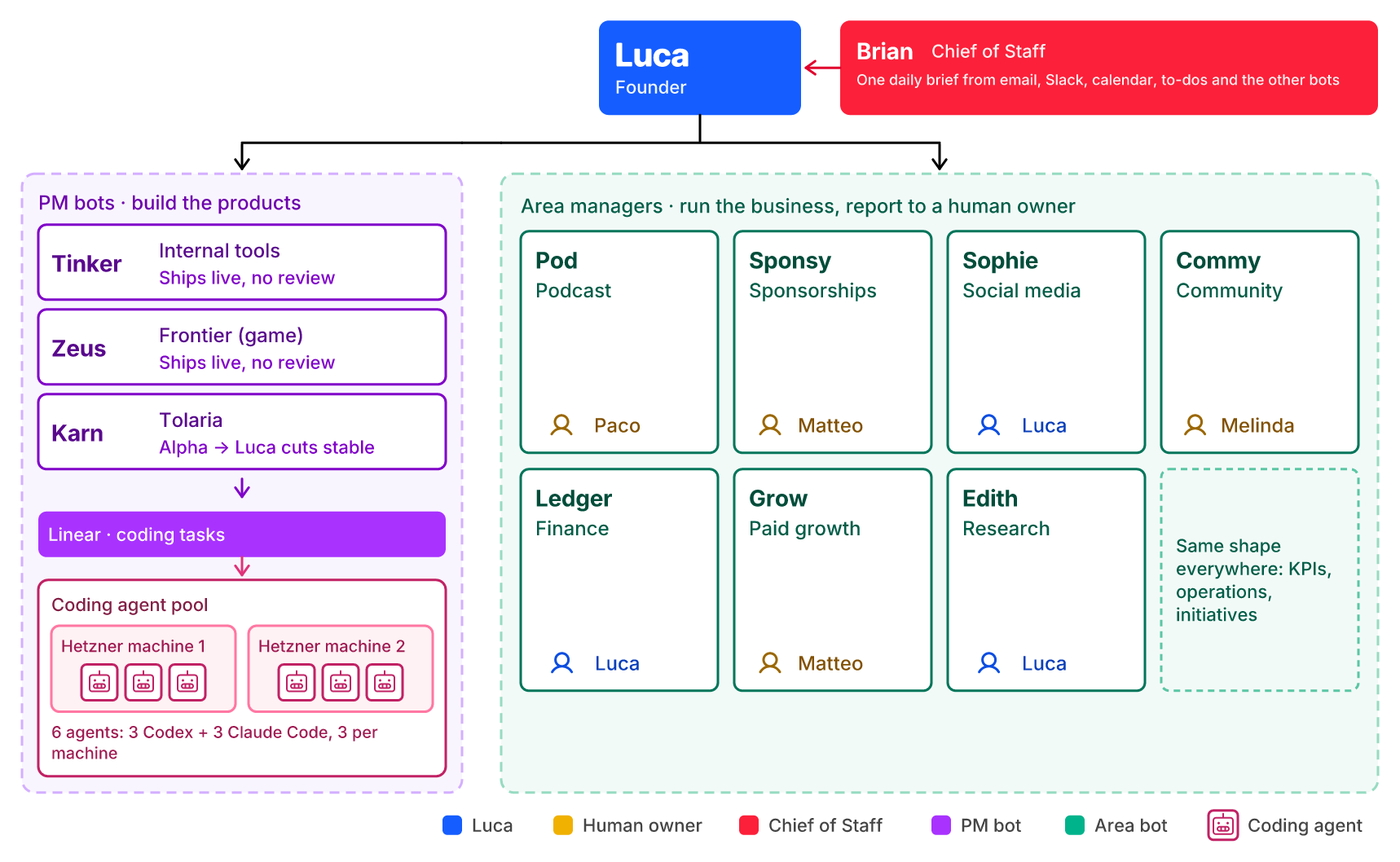
I believe this structure works because of a combination of collaboration patterns. I will cover eight of them one by one, organized into three groups:
Every area gets a manager
Draft everything
A chief of staff for everyone
Area managers
Bots build their own tools
Custom tools as the collaboration surface
PM bots build the tools
Create a feedback loop between areas and PMs
Knowledge should outlive bots
A shared knowledge base in Tolaria
Weekly retros, powered by a… biographer
Let’s look at each of them: