



Hi there! Today’s article is written together with my friend Justin Reock, Deputy CTO at DX. Justin already co-authored a great article about vibe-coding workflows last year, which ended up becoming one of the top 5 Refactoring articles ever, so we have a high bar to clear!
One of the things I like the most about the DX team is that they run an incredible amount of research. They run surveys all year round, and keep a pulse of where the industry is going around several topics — especially AI and developer experience.
They recently released the Q2 2026 AI impact report, the latest in a quarterly series tracking how AI is reshaping engineering teams. I regularly check out these reports, and one thing I noticed is how they gradually moved from discussing adoption to discussing impact.
The feeling is that AI is everywhere now, and the main challenge for engineering leaders is not to spearhead adoption anymore, but rather justify the exponentially-increasing AI budgets, by demonstrating what AI is actually delivering.
I got preview access to the report, and today we will comment on a few key highlights.
So here is the agenda:
📊 Speed is real but uneven — what 500+ teams reveal about where AI gains concentrate, and who’s being left behind.
🧱 Orgs are not multiplying AI output — developer experience is declining even as velocity climbs.
🔬 Code is easier to change but harder to trust — a surprising divergence between maintainability and confidence.
🚶♂️➡️ Spend is outrunning returns — AI budgets are up 28x, but innovation ratio is flat.
🧭 What this means for engineering leaders — how to shift from tool adoption to system optimization.
Let’s dive in!
I want to thank Justin and the DX team for partnering on this! I am a big fan of their work and you should check out the full report here.
📊 Speed is real but uneven
Across the 500+ respondents, over 50% of the code is now generated by AI. This metric has accelerated rapidly, increasing from 34% in Q1 2026.
Median weekly throughput rose 37% over four quarters (1.42 to 1.94 PRs/eng/week), and deployment frequency is up double digits across most segments. However, gains are concentrated among small organizations (less than 100 engineers) and tech-sector teams, pulling away from larger and traditional-industry teams, and the gap is widening.
This echoes what we have seen in other reports recently, from the Acceleration Whiplash, to the State of Software Delivery earlier this year.
The speed at which the tools keep improving makes gains compound for teams who invest into AI workflows, so the distribution of team productivity becomes a steeper and steeper power law, with the top percentiles pulling away from the pack.
🧱 Orgs are not multiplying AI output
DX measures developer experience with a proprietary index called DXI (we talked about it with Abi Noda), which, over the last four quarters, has dropped on average from 67 to 65.
Again this is not an even drop: AI is improving some aspects of the devex (docs quality, code maintainability, onboarding speed) while making others worse: larger PRs, slower reviews, less incremental delivery. In aggregate, the net effect is negative.
Median PR sizes have nearly doubled during the same period — and of course increases in PR size are an early proxy for technical debt, bugs, review friction, and all kinds of nasty stuff.
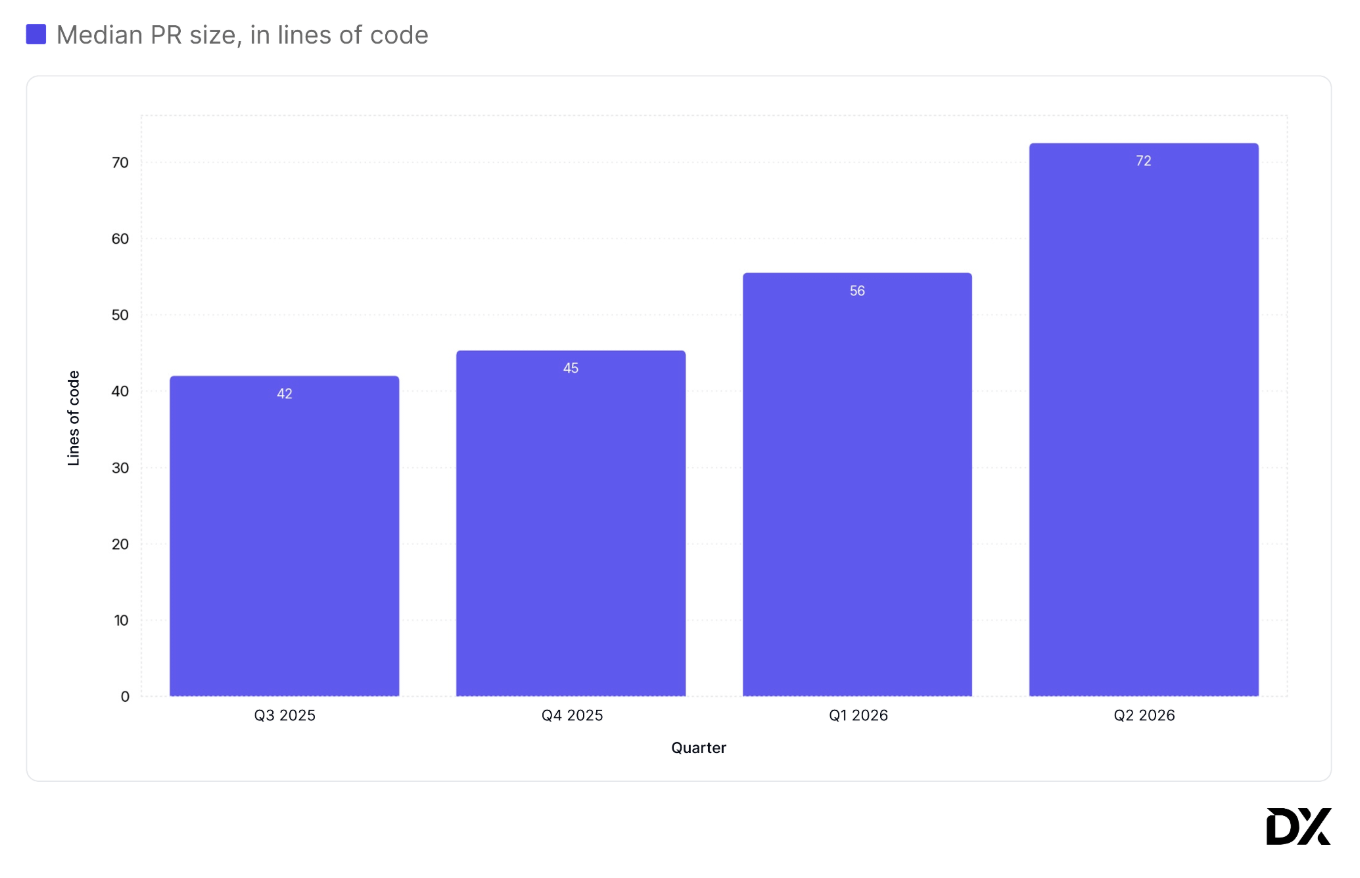
So, velocity metrics alone will tell you things are improving, but devex metrics will tell you that the system (and developers) are strained, and we are far from a sustainable, positive flywheel.
My personal feeling about this is that so far we have mostly tried to slap AI onto the existing steps of the dev process, while running them the same way we always have. This might bring incremental gains, and even work well for some of the steps, but it completely breaks others, like code reviews.
It’s obviously foolish to think that AI can make developers write code 3x faster (as it already does), while assuming we’ll need to keep reviewing every single LOC manually.