


There are a lot of opinions around these days about the future of software, including of course my own.
If you run an engineering team, though, most of these opinions won’t feel useful to you. In fact, when I talk with people about e.g. some AI workflow, I usually get two types of objections:
Volatility — the advice may become obsolete in just a few months, or weeks.
Applicability — the advice doesn’t seem to apply to their team, because of X, Y, Z.
These problems often come together. I’ll give an example.
One of the recent trends about how to work with AI, on which there is more consensus, is Spec-Driven Development. There exist plenty of articles and frameworks to work with it, even created by prominent companies like Github. So it’s not a total consensus, mind you, but it’s about as much as you can get in these messy times.
Still, as a CTO, you may have legitimate worries:
Is this worth investing in? Or may the AI tomorrow (i.e. next month) just figure out more of the specs by itself?
Is this a good fit for our team? How do we harmonize it with how we have been creating PRDs and design docs up until now? Is there a way to work with AI that leverages how we already work, without the need to migrate to a different workflow?
These questions are 100% valid, and the result is often analysis paralysis: teams underinvest in AI because no approach feels durable or authoritative enough to graduate from individual experiment to team practice.
I believe the main problem is that most ideas are just tactical. They may work, but need to be placed within a bigger strategy — a wider map of how to think about our teams, AI, and how to work together.
So today I want to write about the ideas that feel the most durable to me, and on which I am confident we can create good foundations.
These ideas come from many places:
My own experiments — as you saw last week.
Talking with 100+ tech leaders — this year alone in 1:1s, masterminds, and community threads
Our own industry report — where we surveyed 350+ teams and which we’ll release in March
Our cohort program — where I work with a small group of ~10 CTOs and VPs to help their teams ship faster.
All in all it’s like a small think tank, and I am here to report findings!
These findings are actually quite simple (like all good models!), and are about three areas:
🔧 Developer Experience
🪄 AI
🎨 Product Engineering
In my experience so far, these areas work like layers of a pyramid. Each layer creates value only if what’s beneath is taken care of. Think of it like Maslow’s pyramid of software engineering.
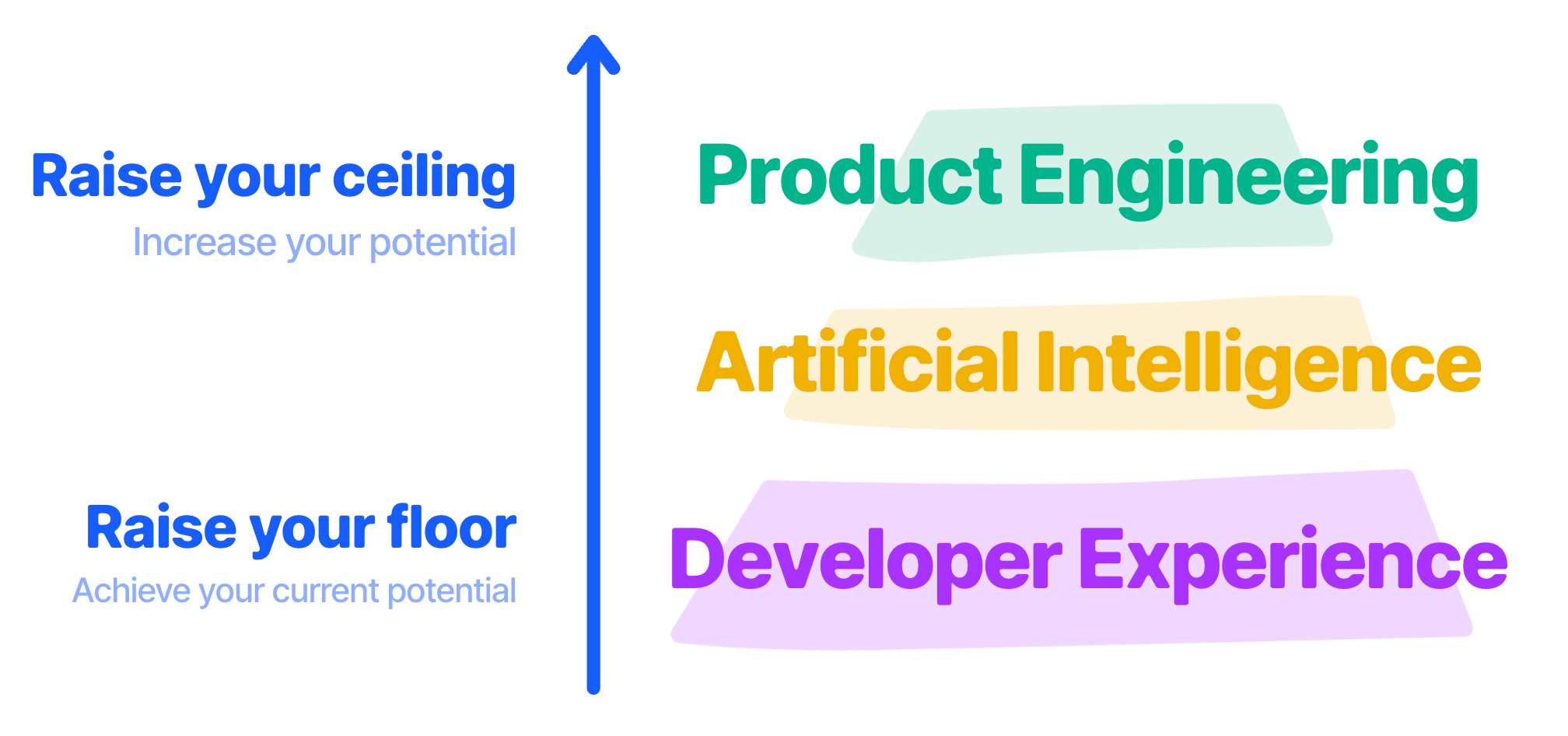
So let’s explore them one by one, recap what we know about them as of today, and how they work together for good.