


Hey, Luca here! Welcome to a 🔒 weekly essay 🔒 from Refactoring.
Every week I write an article to 170K+ engineers about how to make good software together. To get access to all our articles, resources, and our private community, subscribe to the full version below:
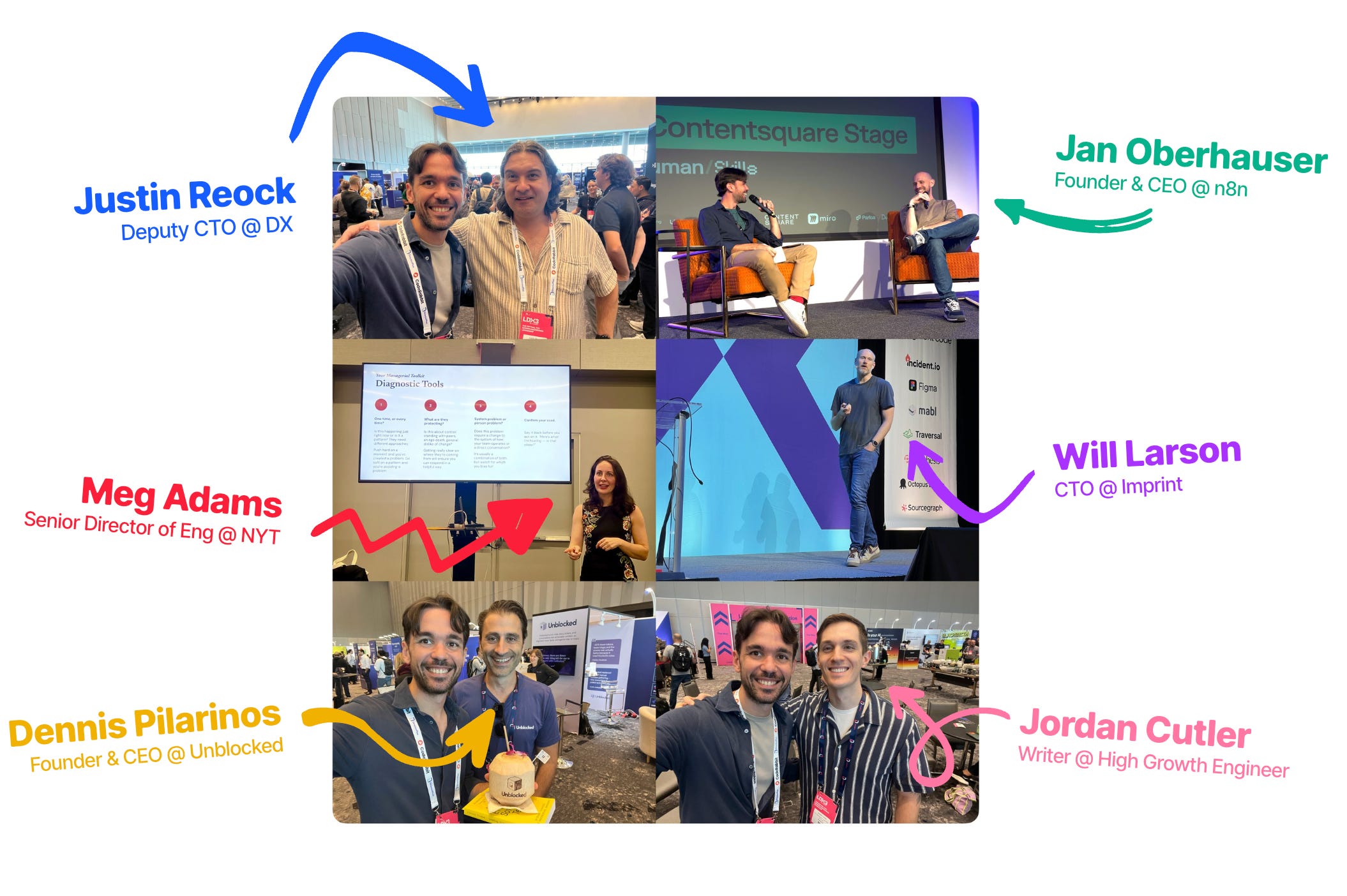
I am back from two weeks of travel, during which I took some time off but also attended two great conferences: LDX3 in New York, and ProductLab in Berlin.
Conferences, for me, are a great way to say hi to friends and to check the pulse on the trends and sentiment in tech. This time made no exception: I learned a lot by attending talks and workshops, and simply by talking with people.
So this week’s edition covers my personal highlights from such talks and conversations.
Here is the agenda for today:
🚚 Doing migrations right — Will Larson on Imprint’s delivery journey, framed as a set of migrations.
🗣️ Guiding people through change — Meg Adams’ diagnostic tools for having hard conversations.
🧭 The Manager’s Path in the Age of AI — Camille Fournier on what still belongs to managers in 2026.
📊 DX quarterly numbers — Justin Reock’s latest AI impact data, plus how I think about these metrics.
🎙️ How n8n is embracing AI — highlights from my conversation with Jan Oberhauser, founder of n8n, in Berlin.
Let’s dive in!
1) 🚚 Doing migrations right
LDX3 opened with a great keynote by Will Larson, who described the delivery journey of his team at Imprint: from manual gates everywhere, to CI/CD, to agentic workflows.
Will’s talk was extremely practical (we need more stories like this), and framed these steps as migrations. We know a lot about migrating code, and most of the same logic can be applied to processes and workflows.
Here are the parts of Will’s approach that stuck with me:
Understanding people’s problems — there’s a reason why people do things the current way, even if it looks flawed. To build something better, you need to understand current problems deeply, which is hard!
Getting buy-in — Will stressed how, even if there was clear top-down input about the direction, the implementation was a collaborative effort where people were involved at all stages. At some point, Will wanted to migrate from Jira to Linear, and started by involving the people who were the biggest Jira fans. He knew that if he could address their concerns, the rest of the team would be easier to migrate to.
Draw hard lines — inclusion and collaboration matters, but once a direction is taken, resources need to go to supporting that direction. In picking AI coding agents, Will settled on making Claude Code the recommended coding tool: people who wanted to use something else could do it, but would not receive support from the platform team.
Sweat the details — with any migration there is always a long tail of stuff to be fixed and edges to be smoothed until things truly work for everyone. Keep working on it even when it seems that “most of the work is done”.
2) 🗣️ Guiding people through change
During LDX3, I attended a workshop by my friend Meg Adams, who I also interviewed last year, about having good conversations with people and guiding them through change.