


Hey, Luca here! Welcome to a new edition of the 💡 Monday Ideas 💡 — ideas and readings to start the week on the right foot.
I also publish an original essay every Wednesday. Here is the one from last week in case you missed it:

📊 AI sped up coding, but not reviews
This week’s newsletter is brought to you by our friends at DX!
AI tools sped up code authoring. Review and release systems haven’t kept pace.

DX’s newest AI Impact Report, based on data from 500+ engineering organizations, shows developers opening far more pull requests each week, each more than twice the size it used to be. As a result, PRs wait more than twice as long for a first review.
Download the full report to see where delivery friction is moving and where leaders should focus next to get the most out of their AI tools 👇
🚚 Treat process changes like migrations
At LDX3 in New York, Will Larson opened with a keynote about the delivery journey of his team at Imprint: from manual gates everywhere, to CI/CD, to agentic workflows.
What I liked most was that he framed each of these steps as a migration.
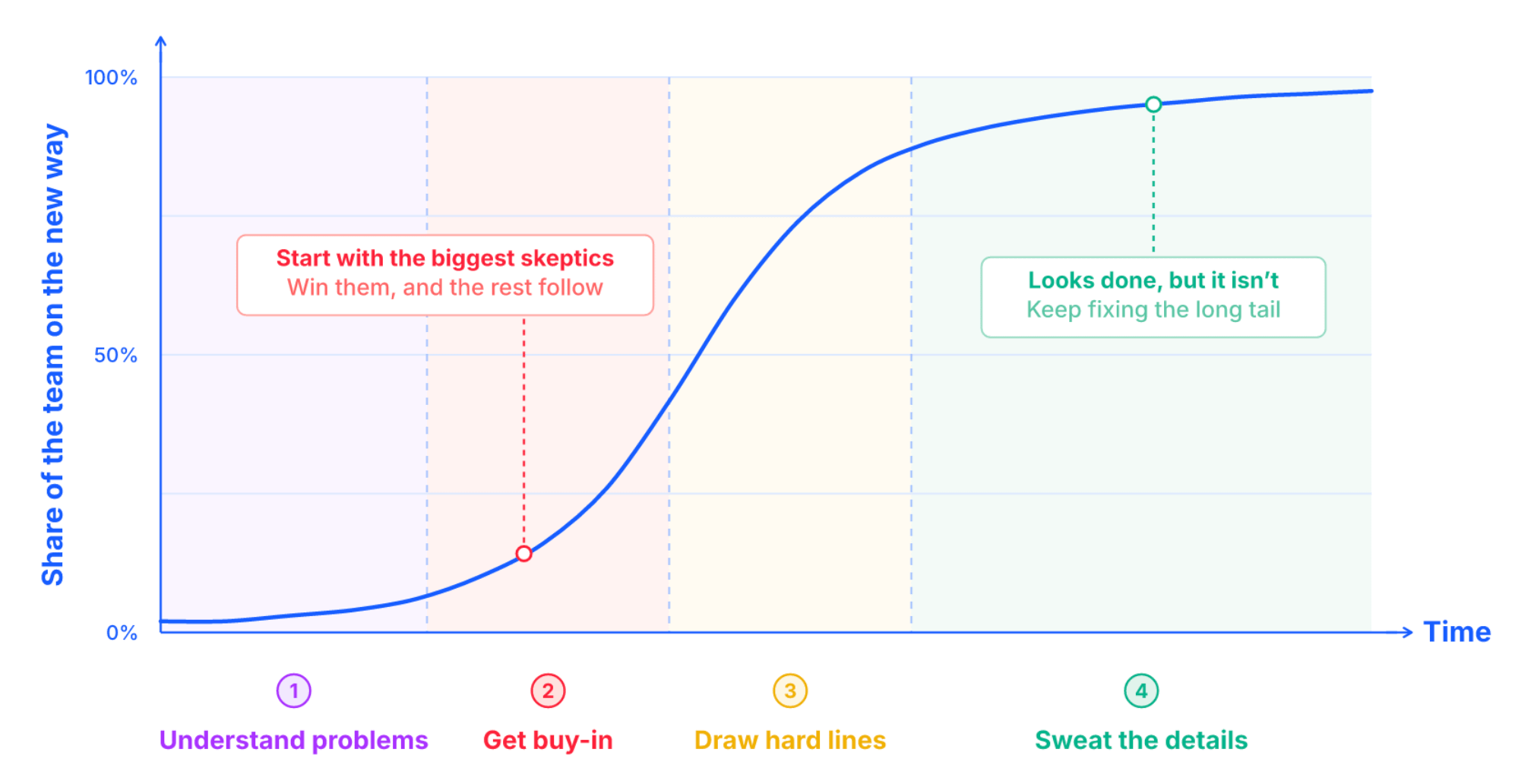
We know a lot about migrating code, and I believe most of the same logic applies to processes and workflows. Here is how Will approached it:
Understand people’s problems — there is a reason why people do things the current way, even when it looks flawed, and to build something better you need to understand those problems deeply.
Get buy-in — even with clear top-down direction, the implementation should be collaborative. When Will wanted to move from Jira to Linear, he started by involving the biggest Jira fans, because if he could address their concerns, the rest of the team would be easier to migrate.
Draw hard lines — inclusion matters, but once a direction is taken, resources need to support it. Will made Claude Code the recommended coding agent: people can still use something else, but they won’t get support from the platform team.
Sweat the details — every migration has a long tail of things to fix and edges to smooth, so keep working on it even when it seems that most of the work is done.
I wrote a recap of my favorite talks from LDX3 and ProductLab, including Will’s 👇

🧰 Treat skills like code
In August I talked with Charlie Guo, developer experience engineer at OpenAI, about how teams are building with agents today.
We spent a lot of time talking about the move from single-player to multi-player: how do you take the productivity gains of a few AI power users and spread them across the team?
Charlie’s answer starts from skills. He organizes them in three tiers:
🧑💻 Personal skills — live in your local folder, and are useful only to you.
📂 Project skills — baked into the repo, and shared with everyone working on that project.
🏢 Organization skills — hosted in internal repositories blessed by IT and security, that anyone in the company can browse and clone.
Skills follow the same lifecycle as regular code: they are version-controlled, discoverable, they have owners, and an update process.
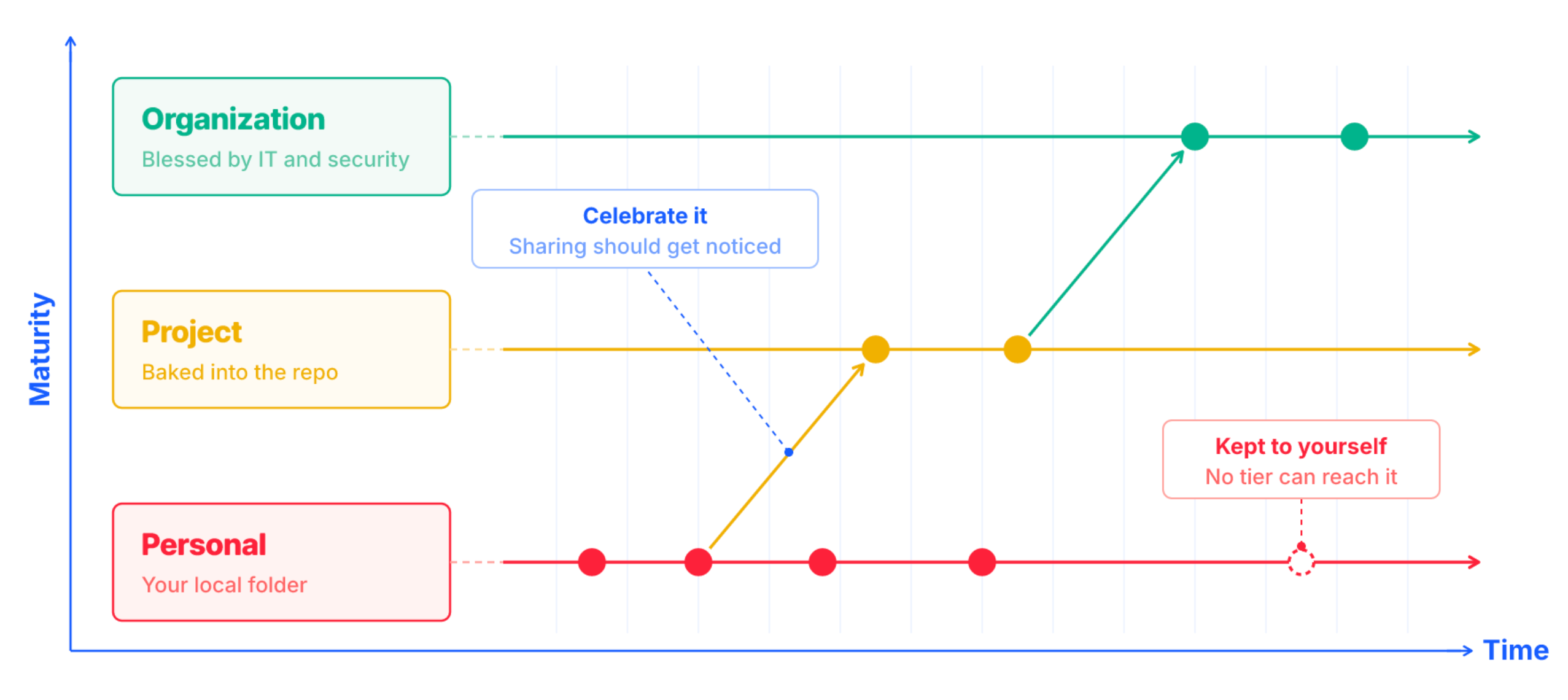
But tooling is not enough. Charlie knows people who don’t share their AI tricks because they don’t want their boss to think they are cutting corners, or because they are stack-ranked on AI proficiency and want to keep their edge. So if you lead a team, you should start from the culture side, and make sure that sharing a good workflow gets rewarded and celebrated.
You can find the full conversation with Charlie here 👇
📚 Weekly Readings
Finally, here are the best articles I have read this week:
🥇 Redesigning Source Control at Anthropic
14 min • by Anthropic
Anthropic went from about 2,500 merged changes per day in May to over 30,000 in September, and git couldn’t keep up. So they built Scion, a custom source control system designed around always-online agents, and moved the whole monorepo off git in five months.
They argue that other companies will hit the same problems soon, and I believe it.
🥈 Hunger Beats Tenure: Advice for Junior Engineers
5 min • by Felix Rieseberg
Felix is a hiring manager at Anthropic, and this month he stopped doing coding interviews, because Claude is better than candidates at them anyway.
He also argues that AI is good news for junior engineers: you can pick a business goal, build one bold idea over a weekend, and skip a lot of the usual red taping.
🥉 The Counting House
32 min • by Steve Yegge
Steve explores a pattern to address huge volumes of repetitive work: cheap models on very tight rails, one case type at a time, scored against the humans doing the same job. It’s the exact opposite of his own wide-open software factory. Long read, but worth it.
And that’s it for today! If you are finding this newsletter valuable, subscribe to the full version!
1700+ engineers and managers have joined already, and they receive our flagship weekly long-form articles about how to ship faster and work better together! Learn more about the benefits of the paid plan here.
I wish you a great week.
Sincerely 👋
Luca
shared skills need a rollout plan too. An edit that helps one repo can quietly change how ten teams review code. I'd version the skill, test the new version against a small set of past failures, then let one team try it before changing the organization default. An owner and an update process are much more useful when there's a way back
That's the same reason I liked the staged-release and rollback layers in the Claude Code review setup I covered here: https://www.the-ai-corner.com/p/ai-code-review-claude-code-team
The part about people hiding their AI tricks so the boss won't think they're cutting corners surprised me. I started Loomhouse in mid-October on the opposite habit, where every build goes out with the prompts and what it cost, and it hadn't occurred to me that inside a company the same openness could feel like a risk. Writing in public, the worst that happens is nobody reads it.