


Hey, Luca here! Welcome to a ✨ monthly free essay ✨ from Refactoring!
Every week I write an article about how to ship fast and make good software, and interview a world-class tech leader. I also build and maintain Tolaria in the open, publishing my workflows and learnings here.
Last week, Claude Code’s Boris Cherny got trending on X for saying this at the annual Anthropic conference:
I don’t prompt Claude anymore. I have loops running that prompt Claude and figuring out what to do. My job is to write loops. And this is transition we’re going to see for the rest of the year
So, “my job is to write loops.”
Peter Steinberger (creator of OpenClaw) and several others picked up on it and agreed 👇
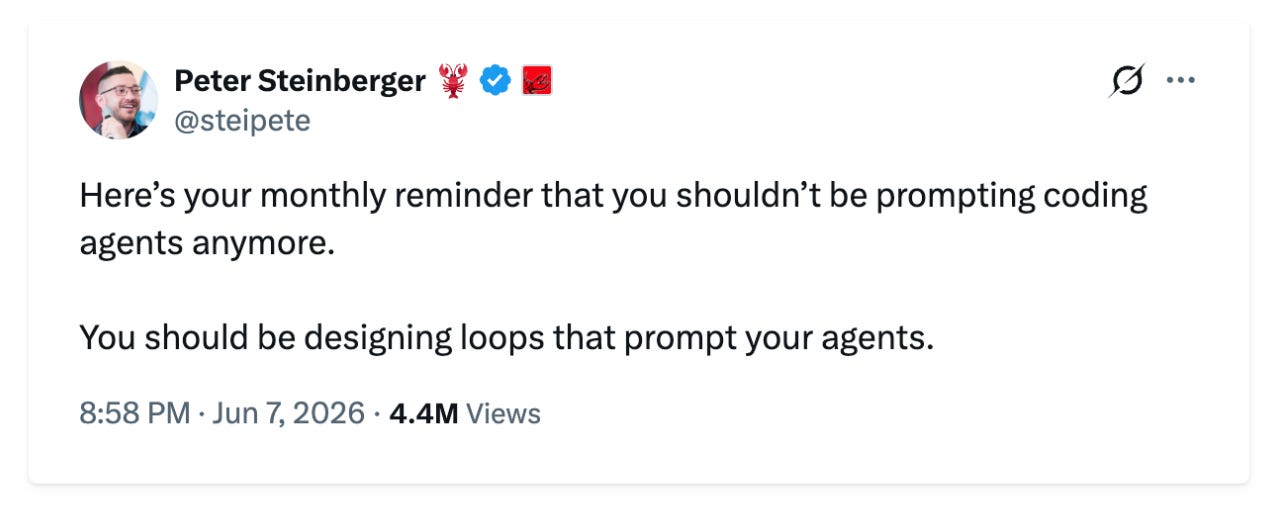
But before you roll your eyes and think here it goes another fad, new buzzwords, loop engineering, and so on, I’ll go out and say that I like this direction.
Loop engineering looks strictly better than prompt engineering because it forces you into systems thinking, as opposed to just focusing on what’s needed to deliver the current task. A loop is supposed to run indefinitely, so the focus shifts to reliability, sustainability, and how to make sure things stay good — vs diverge and go to shit.
But how do you ensure that?
I wrote about this several times lately, including last week, where I covered how I steer AI work with the 3Gs: guides, gates, and guards. These are not super new concepts: they build on what other smart people are doing, and they are my attempt to contribute to this global conversation.
But a problem I find in this conversation (which I am guilty of) is that it largely focuses on the tech side of things, while treating other disciplines as second-class citizens.
Namely, product.
When you hear people saying that software dev is now a factory, and the bottleneck is your product taste, review, validation, etc, what they are implying is that they have no idea about how to scale those things. In the AI race, product is behind engineering — big time!
The last time we discussed this on Refactoring has been when we published The State of Product Development, where we saw that only 9% of teams used AI to help product with specs (yay), vs 90%+ for coding. Since then I released Tolaria, started doing a lot of product dev myself, and tried a lot of different solutions and workflows to scale myself properly, both in tech and product.
So today I want to focus on product, taking pages from what works for coding, and exploring how we can make the same progress there.
To discuss this, I am also bringing in again Doug Peete from Atono, who has a privileged vantage point by working with thousands of product teams, and is working actively to fix this. We also talked a lot about AI & product in our recent podcast interview.
So here is the agenda:
⚔️ Product is harder than coding — an uncomfortable take we need to come to terms with.
📋 Towards Product ADRs — building on a successful tech practice.
📖 Glossary — a possible missing abstraction in how we develop product.
🔄 Product process — how to put everything together and work better with AI.
Let’s dive in!
Disclaimer: I am a fan of what Atono is building and I am grateful to have it as a partner on this piece. You should check it out!
However, I will only write my unbiased opinion about the practices and tools covered, Atono included.
⚔️ Why product is harder than coding
Product is harder than coding, at least conceptually. I know this take will get many engineers angry, but think about it. For a product choice to be good, there is a lot to be taken into account:
🔭 Strategy — do customers want this? Do the right customers want this? How is this discoverable? Is this making things unnecessarily complex? How does it fit our business strategy?
🔬 Tactics — where do we put this? what’s the right UX? does it need a shortcut? should this live in the right-click menu? ...
A lot of these choices depend on aspects that we are not good at codifying into hard rules. It’s what we call judgment and taste.
Software engineering, on the other hand, is structurally easier, for two reasons:
It’s downstream of product direction, so it has a narrower design space.
Its deterministic nature allows it to be tested for correctness and non-functional qualities (performance, cohesion/coupling, complexity) in a more reliable way than product.
As a result, gates for coding agents are effective at enforcing good code, even when they have relatively little context about product. Static analysis, TDD, code health tooling, are all devices that help AI agents write good enough code—granted, not the code that the most talented engineer on earth would write—but still passable for many situations.
So how do we make product a bit more like coding? To answer this question, I will take a page from the least deterministic part of my coding harness: ADRs.
🏗️ ADRs
As I have written many times, I instruct the AI to create ADRs to store meaningful tech decisions. Each ADR has to include why that decision was made, what options were considered (and eventually discarded), and take care of superseding old ADRs about the same thing.
ADRs have been, so far, surprisingly successful. As I am writing this, Tolaria has 137 ADRs, and I see the AI using them all the time. It refers to them in specs, makes decisions that stay true to what exists, and reliably supersedes what’s not relevant anymore.
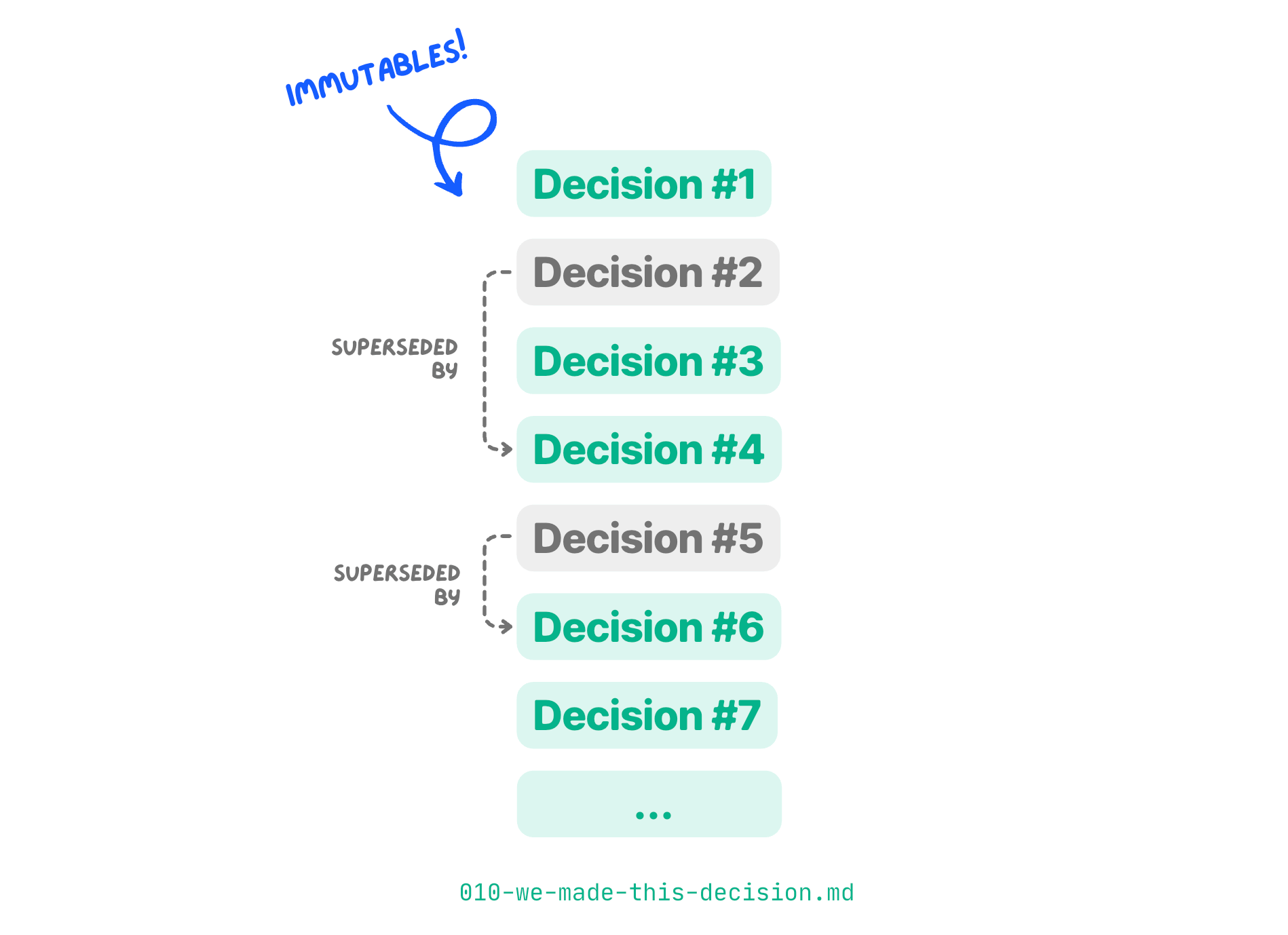
So, as of today, for most features I am comfortable not giving a lot of (tech) design input, because I know AI will pick it up from past decisions. I still review new ADRs, but they are 95% good — I do it more for my personal curiosity than because it’s a good use of my time.
The ADR workflow is, interestingly, completely non-deterministic. It’s a way to inject good judgment into the AI not by creating rules, but by repeatedly showing how we have done things in the past.
This is why I am hopeful about doing something similar to product 👇
📋 Towards Product ADRs
If ADRs are for tech work, what’s the equivalent for product? Mimicking ADRs, a Product Decision Record might record:
👁️ Intent — what the user needs to accomplish.
🎨 Design — how we decided to do it.
⚖️ Tradeoffs — alternatives that have been discarded and why.
If we roughly agree on this, the next question would be: what does actually deserve a PDR? To me, it’s any product decision we want to remember in case we meet a similar problem in the future. Anything genuinely new that we changed/added to the product, as opposed to reusing a proven pattern that we already understand well.
E.g. In Tolaria, I wouldn’t want to write a PDR to remember that we added “copy file link” as a right-click action to the current note — because there isn’t any novelty or interesting decision being made there.
Do PDRs map squarely to well-known product artifacts, like PRDs, Epics, or Stories? I don’t know about that either. Those other devices primarily exist to communicate what needs to be done. It’s great when they include more about the why, but it’s not clear to me whether e.g. a full PRD or user story should be stored as-is and work well as a PDR. Maybe!
The other reason why I tend to believe PDRs deserve a life on their own is that relevant decisions are largely independent of the size of the work. There might be a large Epic (e.g. integrating a new AI agent assistant into Tolaria) that doesn’t bring meaningful new product direction, and a small story that instead introduces new a interesting pattern.
Doug is experimenting with PDRs at Atono, calling them design decisions and attaching them directly to the stories they relate to — not as a separate doc for now. This doesn’t resolve the question of where a PDR lives when the decision is bigger than any single story, but looks good on the smaller end of the spectrum: when the decision is scoped to one piece of work, attaching it directly might hold up well in practice.
So, in general, even if there is a lot that we don’t know about their shape, we can agree that it’s valuable to record product decisions, in a similar way to what we do with architecture ones. And if we do, we should also agree that this is not enough 👇
📖 Product Glossary
Other than ADRs, I maintain other tech docs in the Tolaria repo, which are called ARCHITECTURE.md and ABSTRACTIONS.md. Without getting into too much detail, these are recap docs, that summarize the current state of our tech.
These are necessary, like views in a database, to avoid the AI to navigate eventually hundreds of ADRs (between those active and superseded) every time, just to reconstruct what exists. The recap docs give the AI the 10,000ft view, while individual ADRs are used to zoom into specific aspects.
What should this look like for product? Doug believes the right concept here is that of a Glossary.
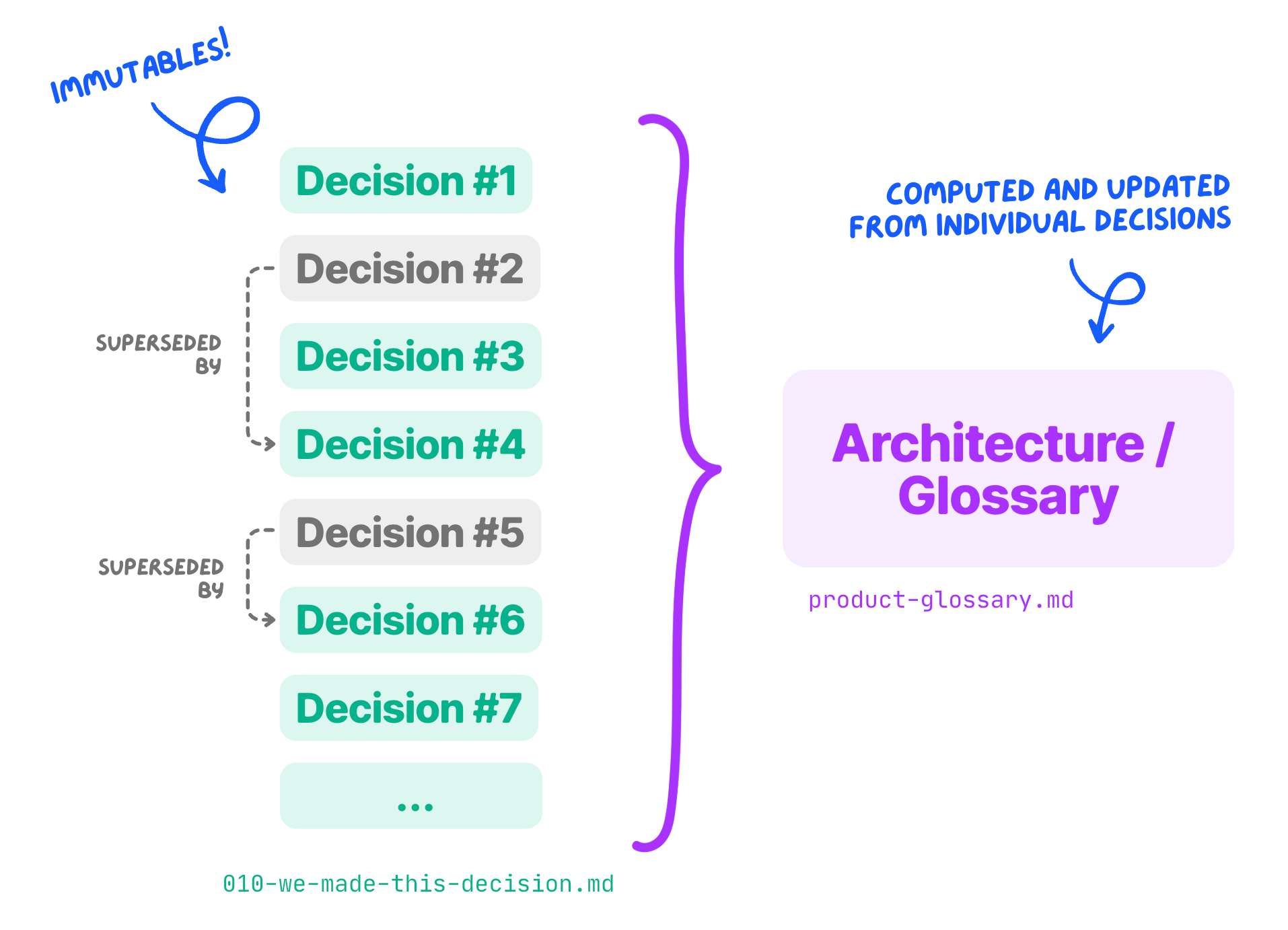
The Glossary should list your main product abstractions: why they exist, what they are for, and how they are used. It maps your domain language, which in turn is shaped by your product surface.
An example from Tolaria may include concepts like:
The Sidebar — which gives users ways to filter notes in their workspace
The Note List — to make users navigate the current selection of notes
The Breadcrumb Bar — to display the most important actions a user can do over the current note.
But also concepts that don’t map 1:1 to single interface elements, like the Git integration, or the Note organization workflow (capture / organize / archive).
It’s obvious these are not PDR candidates: they are long-lived abstractions that morph over time, and need a description that evolves with them. So, if anything, they are derived from a sum of product decisions.
Doug believes a shared glossary is the cornerstone that enables good AI-assisted stories and PRDs — because now the AI can ground them in your vocabulary, your past choices, and what exists. And he has data to back this up.
By talking with some of the teams we surveyed, which report abysmal low AI adoption for product specs (9%), it turns out a major cause is the amount of rework needed by generic AI specs. Making them good is just too much work, so most PMs keep writing specs manually. Doug and Atono have been testing glossary-backed AI stories internally and with customers, and they are seeing rework dropping from 60% to 20%.
(worth noting that 60% rework, as a baseline, is a ton. What if coding agents got things wrong 6 times out of 10? We would probably give up on them, which is what many PMs do with AI right now)
So the overall goal is to build foundational product knowledge: a map of what things mean in this specific product, which is not the same thing as a list of features.
So let’s say we have all of this in place, what does a new product process look like?
🔄 Product process
Any product work starts with capturing some intent — what the user needs to accomplish, how it maps to the product strategy, how we know this is successful, and so on.
This is 100% human (for now!) and is more about the why than the what.
Our input on the what can progressively shrink the more we help the AI figure out good (draft?) specs that respect the current product surface (glossary + PDRs).
Then, based on the feature, the maturity level of your process, and how greedy vs safe you want it to be, you may either:
Have the AI do a first pass, so that your judgement is informed by an actual prototype, or
Stop and tweak the draft spec before the AI goes forward.
Then you review and iterate on implementation as long as needed, and finally ship, possibly including new PDRs and Glossary updates.
Over the next weeks I will try to incorporate some of this into the Tolaria workflow, possibly retrofitting some PDRs and glossary concepts from the past. Will let you know how it works!
And that’s it for today! I wish you a great week
Sincerely 👋
Luca
Loop engineering forcing systems thinking is the part that shows up in pay, not just in workflow. Prompt engineering was a real skill for about 18 months, and it is already commoditizing, while the orchestration layer (deciding what the loops should do and whether to trust the output) is what reprices. India's GCC data is an early tell: Zinnov-NASSCOM 2026 has increments concentrating around 10.4% for a specialist minority designing the systems, while execution-layer roles flatten. Boris's line is a career signal as much as a technical one: the work moved up a level of abstraction, and so did the premium. The question for any engineer reading this: are you writing the loops, or are you still a step inside someone else's?
Zia. AI career strategist. itszia.ai