


Hey, Luca here, welcome to a weekly edition of the💡 Monday Ideas 💡 from Refactoring! To access all our articles, library, and community, subscribe to the full version.
Stop babysitting your agents 🍼
Today’s sponsor is Unblocked!
Agents can generate code. But getting it right for your system, conventions, and past decisions is the hard part — you end up wasting time and tokens in correction loops.

More MCPs give agents access to information but not understanding. The teams pulling ahead use a context engine to give agents exactly what they need.
Join our friends at Unblocked on April 23 (FREE) to see:
Where teams get stuck on the AI maturity curve
How a context engine solves for quality, efficiency, and cost
Live demo: the same coding task with and without a context engine
💡 Developer Experience is your floor
By now we all largely agree that AI amplifies your existing dev practices — good and bad. I think what most people don’t realize is just how strong the amplification is.
Last month I commented on the recent State of Software Delivery report. With respect to one year ago, the median team sees:
📈 +15% activity on feature branches
📉 -7% activity on the main branch
📉 -15% success rate on the main branch
These numbers are brutal: the average team sees exactly zero impact from AI. Even negative in some cases, as displayed by activity on the main branch.
On the other end, if you look at the top quartiles, the reality is different. Top 5% teams are ~2x as fast, with the same success rate. Top 10% teams are +50% faster, and top 25% are +25% faster.
These are big numbers, and they come from the teams who were already at the top 3 years ago. So, paraphrasing the famous quote, the best time to invest in good devex was years ago, but the second best time is now.
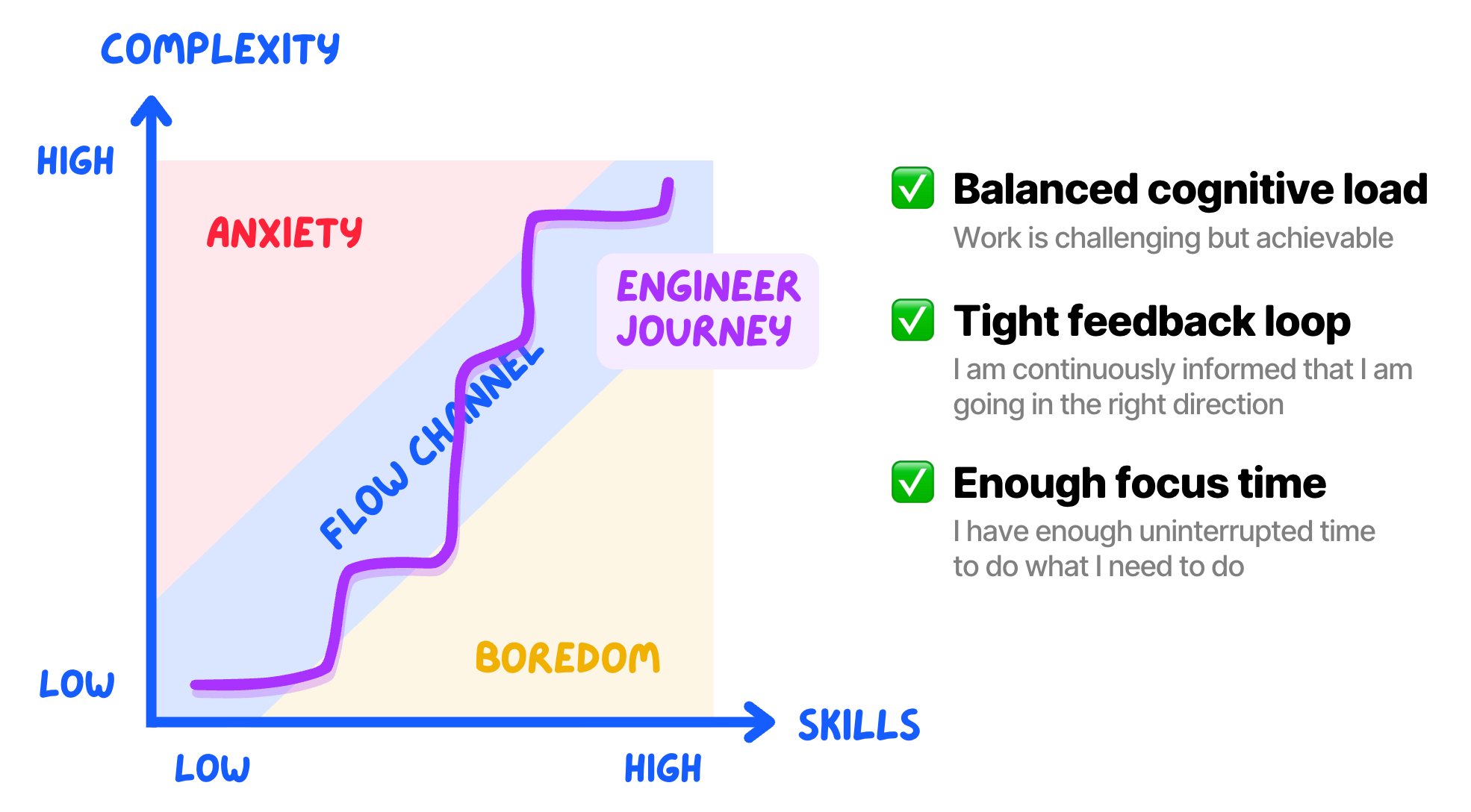
Good devex is the floor that enables a team to profit from AI. I like the idea that good devex is enabled by three factors:
🧠 Balanced cognitive load — work is challenging but achievable.
🔄 Tight feedback loops — engineers are continuously informed that are going in the right direction.
⏱️ Enough focus time — engineers have enough uninterrupted time to do what they need to do.
When these three things happen, engineers can enter a flow state: complete immersion in their activity with extreme focus, productivity, and personal enjoyment.
Here are some questions you can ask yourself to assess where you at with these:
Reduce cognitive load → What feels hard as a developer? How can I make it easier?
Tighten feedback loops → What feels slow? How can I make it faster?
Improve focus time → What feels wasteful? How can I reduce interruptions?
I wrote a full piece about DevEx, AI, and Product Engineering, and how these are the new pyramid of software engineering 👇

🎙️ Why did the day need saving?
Last year I interviewed Rands—one of my heroes—and we talked a lot about AI, engineering management, and things we are getting wrong in tech.
Rands believes, as an industry, we are too attached to hero culture that celebrates heroics and save-the-day moments.
“Good job saving the day. Why did the day need saving? We screwed up and you had to save the day so good job cleaning up your screw up.”
Rands believes in proactive prevention rather than reactive heroics: addressing issues when they are still yellow flags, instead of big red ones. Effective management goes unnoticed because teams function smoothly — but that should be a badge of honor.
Acts of prevention sometimes are hard because they go against your instincts, like giving early corrective feedback before problems escalate. It feels easy and innocuous to avoid these small-scale conflicts, but these are exactly what you need to prevent the big fuck-ups.
Here is the full interview with Rands:
You can also find it on 🎧 Spotify and 📬 Substack
📚 Weekly Readings
Finally, here are the best articles I have read this week:
🥇 Who Will Be the Senior Engineers of 2035?
11 min • by James Stanier
Great article by James, who put together a lot of resources and ideas (also from different industries), and connected the dots to understand what may happen to the software engineering job market. Recommended read.
🥈 Open Source Isn’t Dead
3 min • by Alex Schapiro
Cal.com recently announced it’s going closed source, citing AI vulnerability scanning as the #1 reason. This piece pushes back, and I actually agree with it: closing source code doesn’t remove the attack surface — AI can still attack you black-box, at runtime. The better response is continuous AI defense (fire with fire!).
🥉 Agents as Scaffolding for Recurring Tasks
4 min • by Will Larson
Great practical pattern for introducing agents into your workflows: start by prototyping with agent-driven automation, then refactor some agentic parts away into deterministic code, keeping the agent only where it truly shines: navigating ambiguity.
And that’s it for today! If you are finding this newsletter valuable, subscribe to the full version!
1700+ engineers and managers have joined already, and they receive our flagship weekly long-form articles about how to ship faster and work better together! Learn more about the benefits of the paid plan here.
See you next week!
Luca