


Hey, Luca here! Welcome to a new edition of the 💡 Monday Ideas 💡 — ideas and readings to start the week on the right foot.
Brought to you by our friends at Atono!
You hand off a story to an agent. The code works, it ships, but it’s not what you meant.
As agents move faster, the decisions that shape what gets built need to travel with the work. Most teams haven’t systematized this yet, so the result is correct implementations… of the wrong thing!
Atono just published their From Intent to Production at Agent Speed guide, showing how product knowledge becomes your leverage point for keeping decisions intact, even at agent speed.
We’ve previously collaborated on pieces like The State of Product Development 2026 and The AI Productivity Paradox — this guide goes deeper into product delivery for agentic workflows 👇
1) 🏗️ Agents are great scaffolding
A mistake I see more and more with AI workflows (including mine!) is using AI for everything, even for parts that would be better done in other ways.
That’s easy to fall into, because when you are automating a new recurring task, an agent is often the fastest way to start. You can give it the goal in natural language, let it run the process end to end, and observe what happens. This is not only quick to do, it’s also useful because, at the beginning, you often do not know the real shape of the work yet.
So the agent helps you discover things like:
which steps repeat every time
which data is missing or messy
where approvals are needed
which parts require actual judgment
and more
Once the workflow becomes clear, though, the boring parts should be extracted into something more deterministic: scripts, APIs, cron jobs, workflow definitions, or whatever tool fits the job. That makes the workflow faster, cheaper, and easier to observe and debug.
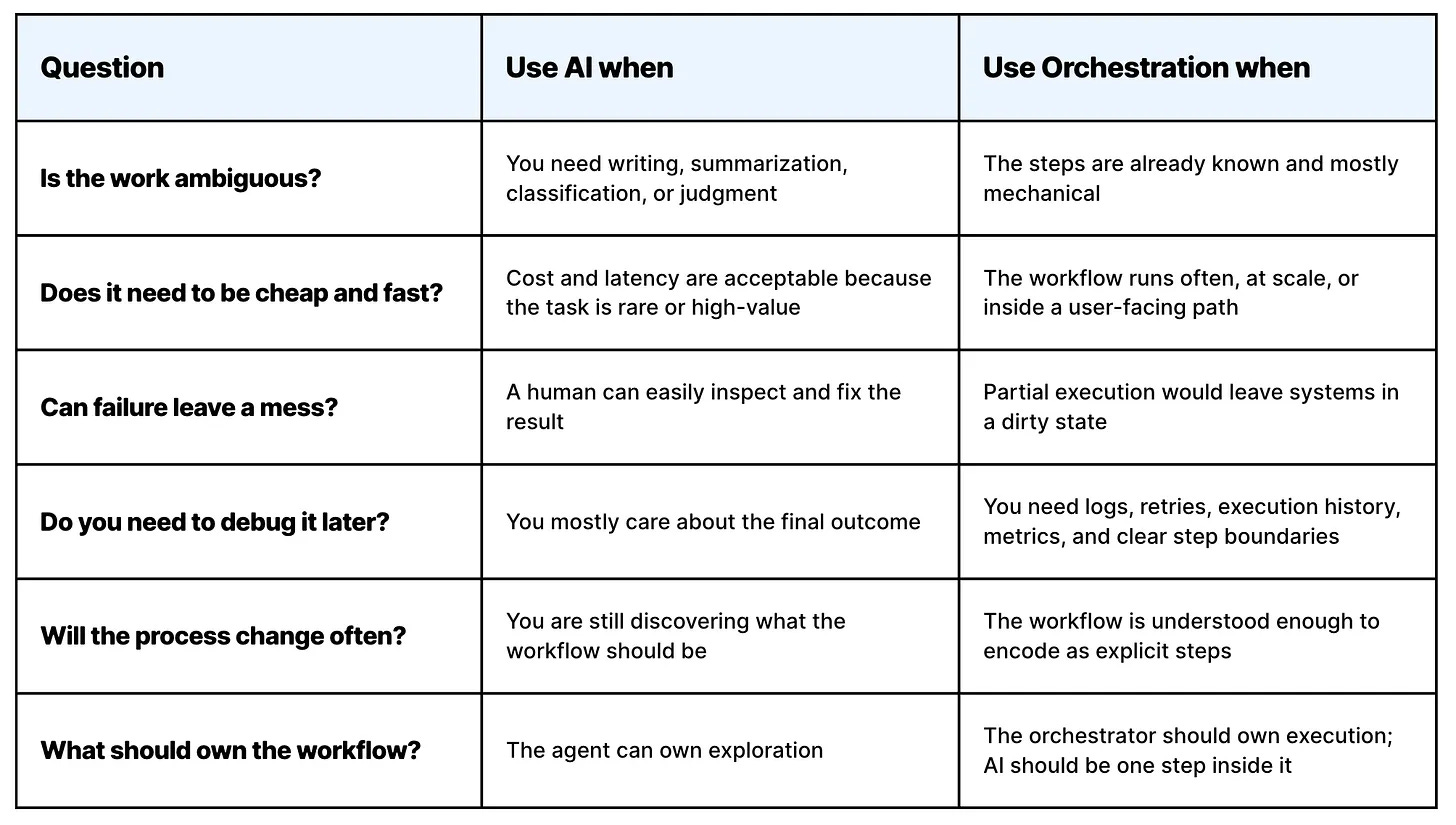
These days I try to keep AI where flexibility is valuable (e.g. judgment calls), and replace it where determinism is cheap. Most often, it’s a progression: I start with an agent because it is fast, observe where the task repeats, harden the stable steps, and leave the ambiguous parts to AI.
I wrote more about this in the full piece on orchestrating AI workflows 👇

2) 💬 Giving feedback should be ordinary
Feedback is often treated like a special event. It’s the performance review, or the difficult conversation we should have had long ago, or the moment when something went wrong enough that somebody has to say something.
The problem is that, if feedback only appears in those moments, people learn to associate it with danger. They hear “can I give you some feedback?” and brace for impact.
In my conversation with Jean Hsu and Cate Huston, two professional coaches, Cate shared a better habit: every time someone does something good, tell them.
When people receive frequent, specific positive feedback, they learn that you are paying attention to their work as a whole, not only waiting for mistakes. Then, even when you eventually need to say something corrective, it lands differently.
You can also spread this beyond yourself. When someone praises a colleague privately, ask: “have you told them?” Over time, feedback stops being capital-F Feedback and becomes normal signal in the system.
You can find the full interview with Jean and Cate here 👇
3) 📚 Weekly Readings
Finally, here are the best articles I have read this week:
🥇 The Tower Keeps Rising
3 min • by Armin Ronacher
I really like the Babel analogy applied to how we cooperate as humans and, ultimately, software. For the first time, “construction” can keep going even after humans have lost the shared language needed to reason about the system. Food for thought.
🥈 Generated and Suppressed Demand
3 min • by Will Larson
A useful mental model for why fixing a struggling team can feel like nothing improved. Sometimes the team gets better, and the reward for it is... more work! All the previously hidden demand finally shows up. Great management advice, as always from Will.
🥉 Control the Ideas, Not the Code
6 min • by Salvatore “Antirez” Sanfilippo
Antirez makes a clear point that many engineers are still resisting: if AI writes more code, reviewing every line is probably the wrong use of your time. You have more leverage when you focus on ideas and design.
And that’s it for today! If you are finding this newsletter valuable, subscribe to the full version!
1700+ engineers and managers have joined already, and they receive our flagship weekly long-form articles about how to ship faster and work better together! Learn more about the benefits of the paid plan here.
See you next week!
Luca
the progression you describe is IMO also the sharpest test of what your job actually is.. when you feed a recurring workflow to an agent, the parts it nails in minutes were never the work, they were just the parts that felt like work.. what is left after you harden them is the residue nobody has a template for, the judgment calls.. that residue is the whole job, and it is smaller than most of us want to admit
The distinction between using AI to discover the shape of a workflow and then hardening the repeatable parts I personally think it pretty good. But maybe the question isn’t ‘how do I automate this?’ but ‘which bits actually deserve to remain flexible?