


Hey, Luca here! Welcome to a new edition of the 💡 Monday Ideas 💡 — ideas and readings to start the week on the right foot.
TRM is AI intelligence for public safety — and it’s hiring! 📣
This newsletter is brought to you by our friends at TRM!
TRM models turn petabytes of data into actionable intelligence across the threat landscape: ransomware groups, human trafficking networks, darknet markets, terrorist financing, and more!

Threats don't wait. And neither does the TRM team.
Engineers at TRM work at a scale most never touch: real-time graph traversal, petabyte-scale pipelines, and models that power investigations with real-world impact. If you want your code to catch criminals, this is where you build it 👇
🧮 Map and score devex problems
Most teams have structured ways to work on customer problems — which we call “product” — but do not apply the same rigor to developer experience issues.
Earlier this year I advocated to do a listening tour with your engineers to uncover devex problems. An important part of the tour is not to stop at the uncovering stage: you should map, score, and prioritize issues so you work on the right things.
Mapping means taking stories — situations where bad things happened — group them together into friction points, and map them to steps of your dev process.
You can reuse the story map format for displaying this, but you don’t have to necessarily do it that way. You can use a spreadsheet or anything else.
The outcome might be something that looks like a three-level investigation that includes steps, problems, and stories 👇
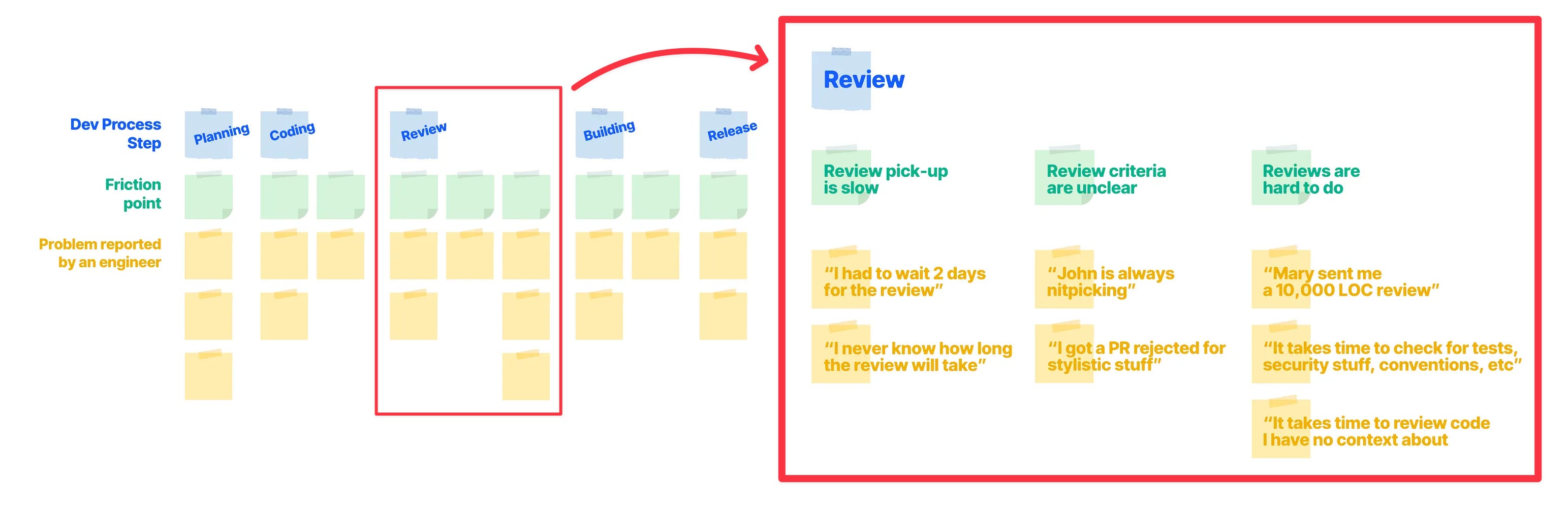
After you collect problems, it’s time to score them. To do that, the most useful coordinates I have found are reach and impact:
Reach — how many engineers are impacted by this
Impact — how much disruption it causes
If this makes you think of RICE, we are not including:
Confidence — because it’s often tricky to figure out and I haven’t found it that useful in real life, nor
Effort — because we are only talking about problems here, not solutions.
Also, I am a fan of using simple scores, like low-medium-high, or 1-5.
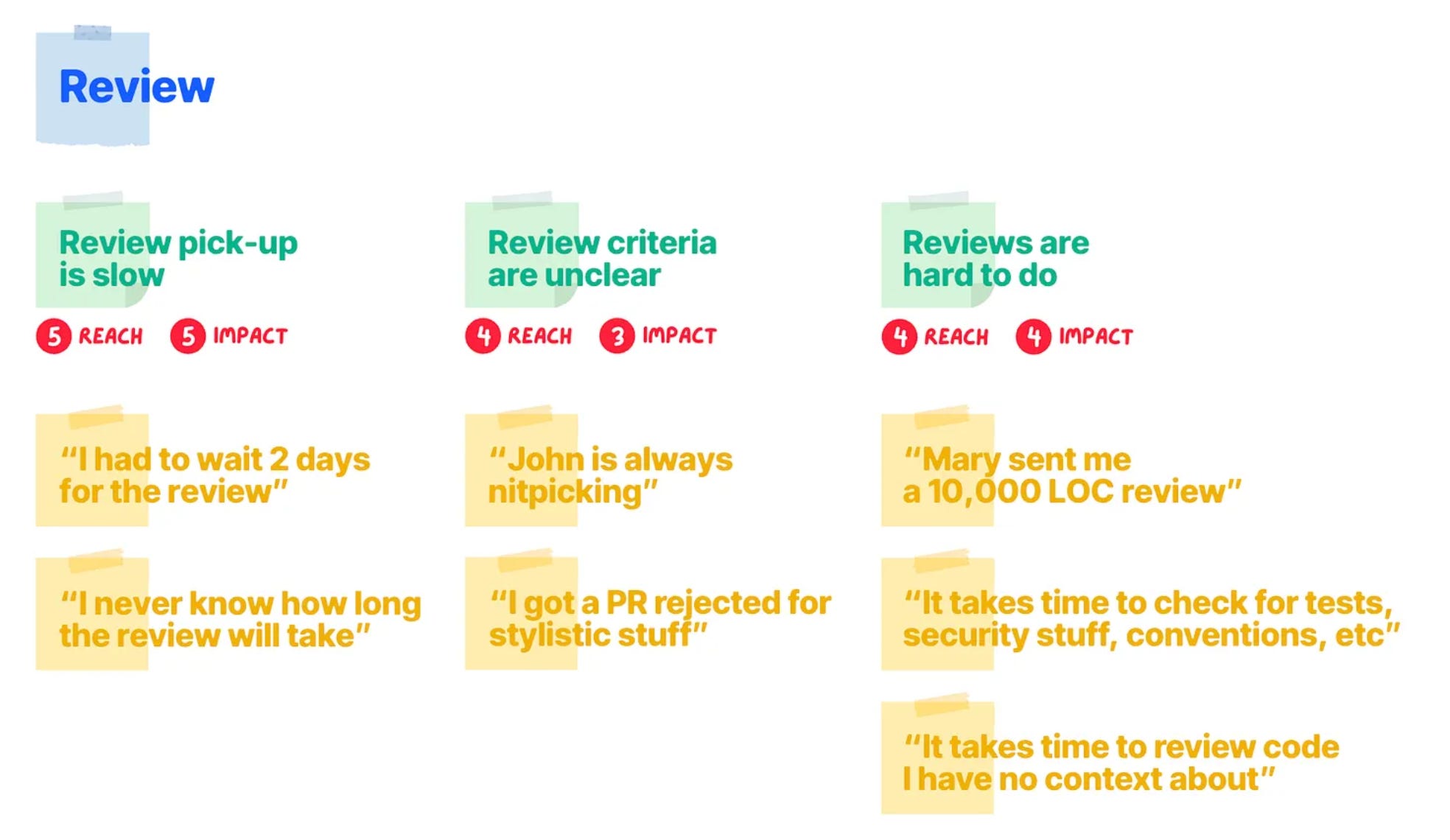
After that, you should focus on the one true bottleneck™ — I wrote more about that in the full article 👇

🪜 Career direction starts with what you want
Career planning starts getting useful when you stop asking only what the ladder says and start asking what you actually want.
Many engineers sleepwalk through their careers by following the next obvious step: promotion, bigger scope, manager track, staff track, better company, higher comp. Those may be good goals, but they are not a substitute for knowing what kind of work makes you thrive.
Last month I interviewed Jean and Cate, two professional career coaches, and they told me they are a fan of asking two simple questions:
What was a peak moment in your career?
What does it look like for you to thrive?
They asked them to me and I had to think for a minute or so. These questions are designed to pull attention away from abstract “prestige“ and toward real-world evidence. When did work feel energizing? What kind of contribution mattered? What environment made you stronger?
Also, the answer does not need to become a ten-year plan. In uncertain times, an horizon of a few months may be more useful: try something, observe how it feels, adjust, repeat.
Career direction is built every day from good reflection and experiments.
You can find the full interview with Jean and Cate below 👇
📚 Weekly Readings
Finally, here are the best articles I have read this week:
🥇 Why Japanese Companies Do So Many Different Things
20 min • by David Oks
This is such an awesome article that goes deep into explaining how (and why) Japanese companies are wildly different from US (and Western in general) ones. So much food for thought from looking at things like lifetime employment, horizontal coordination, diversification, and more. A must read.
🥈 The Slide
5 min • by Rands
Putting this appropriately here after I interviewed Rands at LDX3 just last week, and asked him about stories and this article in particular. When someone keeps ignoring your feedback, don’t lecture harder — slide up next to them with a personal story about the time you struggled with the same thing.

🥉 Making a New Plan
2 min • by Cate Huston
An ever-underrated leadership skill is admitting you’re wrong and making a new plan when new information is available. Also, it’s easy to judge others for not doing that, until you realize we all do it from time to time. Short and sharp, as always in Cate’s style.
And that’s it for today! If you are finding this newsletter valuable, subscribe to the full version!
1700+ engineers and managers have joined already, and they receive our flagship weekly long-form articles about how to ship faster and work better together! Learn more about the benefits of the paid plan here.
See you next week!
Luca