



Hey, Luca here! This is a guest article written by my friend Umberto Nicoletti, Director of Product and Engineering at Proemion.
Umberto has had an incredible 25-year career in tech, and recently wrote a series of reflections about it on his blog. I loved them and asked him to consolidate them into a long-form version for Refactoring, so here we are!
Find yourself a comfy place, get a hot beverage if you fancy so, sit down and I hope you enjoy the reading!
When we read stories of successful people, they always seem to be going in a straight line, where each decision gets our hero one step closer to their goals, all part of a flawless execution which appears to be planned from the very beginning.
This story will no doubt look the same, but that’s far from being the truth.
I will omit the sleepless nights, the long working days, the spite, the anger and sometimes the regret that have peppered what might otherwise look like a fairy tale.
When we tell stories, hardship is easy and sometimes convenient to forget, but it’s as much a part of who we end up being as the successes are. So while you read this, cut yourself some slack. If you are currently struggling, or have been, do know that it’s ok — we all struggle, and no, we haven’t figured it all out either.
By the time I am writing this I have been employed professionally in ICT for ~25 years, starting on a peculiar date: April 1st 2000.
I had started using computers semi-seriously a few years earlier, in 1996. And in 1995, three things had happened around me:
Microsoft launched Windows 95 — which got the whole world excited about personal computers at an unprecedented level of popularity.
The Internet became a thing — it was mentioned on TV and you might get it at home, for free, with dialup.
I was about to start university — and was looking around at what field to pursue.
For me, the decision couldn’t have been easier: it had to be Computer Science! Deep down I knew that the Internet and the World Wide Web would end up changing the world (if anything, I underestimated how much) and I wanted to be a part of that.
Also, and that helped although it was not the main reason, it appeared to be offering a promising career because demand was exponentially outgrowing supply.
Only 30 years later I would discover that this intersection of events is what the Japanese call ikigai.
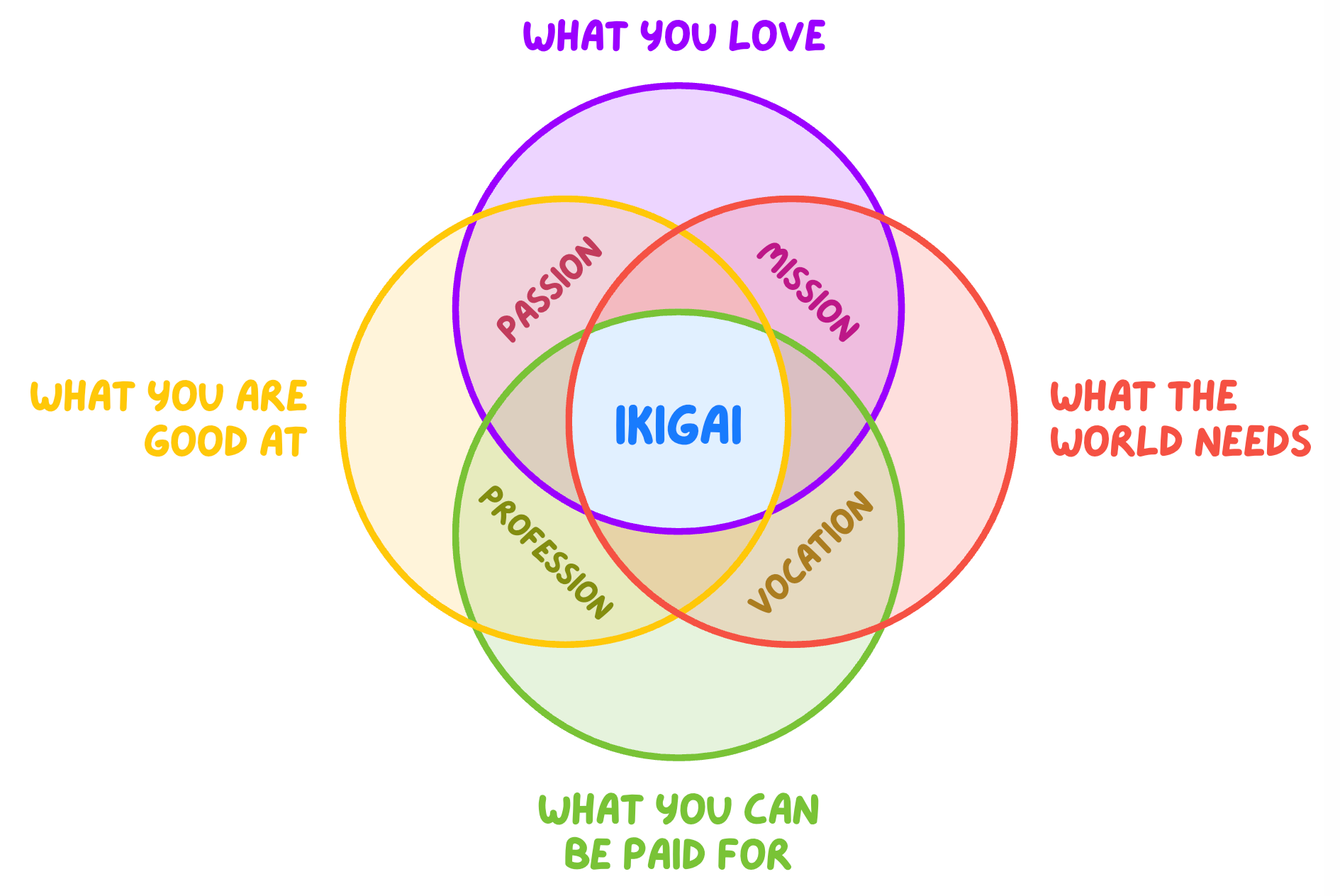
Ikigai1 is used to refer to a passion that gives value and joy to life, by sitting at the intersection of four pillars:
🌎 What the world needs
❤️ What I love doing
💪 What I am good at
💰 What I can get paid for
My sustained enjoyment of this work, 30 years on, is a direct result of the inherent purpose at the convergence of these four pillars 👇
Let’s explore how, by organizing this journey into three stages:
🎓 University & Open Source — the messy beginnings!
🔌 Power Adapters and DevOps — how a lucky encounter set off my career
💂♂️ Head of R&D — growing by playing the long game, coaching, and communities.
Let’s dive in!
🎓 University & Open Source
While at university I did something that, when I look back at it, I would say it was pretty reckless (at least for the time, or my family): I joined the Erasmus program2 as an exchange student. That gave me a chance to refine my English to a level that would have been otherwise unattainable. This was the end of the ‘90s when very few people spoke English and translators were still a booming business.
This hardly gained English fluency would prove supremely useful in the following years.
My first job out of university was glamorous (for the time) and came with a lot of wiggle room: I worked for a small tech company that dealt with large customers (mostly healthcare) and, when everybody was still writing desktop applications, was betting big on web ones. The job required sacrifices because it had a long commute, but I accepted because I intuitively grasped that it would allow me to gain experience not possible otherwise.
Having the company started out as an internet POP (point of presence), they also offered email and web presence services, which allowed me to tinker with mail servers, systems and network administration, web applications, databases, pre-sales, and even IT helpdesk.
This varied experience shaped me into an extremely versatile resource, and I still think is my greatest asset today.
They were also deeply committed to Open Source Software, which meant that I would get to play (and sometimes contribute back) to some projects we used. Spoiler: it was through one of these projects that I eventually got to know the person that would hire me at my current job.
I stayed at this job for a (relatively) long time because I liked it and it was my ikigai. But I was growing anxious to prove my worth outside a circle that I started finding boring.
As I said, I’ve been an avid Open Source user who contributed back as often as I could. Last time I checked—a decade ago—I had a level 2 fosser and Kudos rank of 8/10 on Blackduck (formerly Ohloh) which, quoted from their own page of the time was “relatively uncommon, with about only 6% of the population receiving this rank”.
This reinforced my desire to look for a new challenge 👇