


Hey, Luca here! Welcome to a new edition of the 💡 Monday Ideas 💡 — ideas and readings to start the week on the right foot.
I also publish an original essay every Wednesday. Here is the one from last week in case you missed it:

Hyperscale Remediation: Autonomously Secure Your Software Estate
This week’s newsletter is brought to you by our friends at Blitzy!

Security teams don’t need another list of alerts. They need to know which vulnerabilities are reachable, exposed, and safe to fix. Blitzy understands your entire software estate and, through Proactive Insights, surfaces known and previously undiscovered vulnerabilities in the enterprise codebase and remediates them autonomously. It traces each finding through execution paths, identifies dependencies, and validates remediation. Blitzy then turns prioritized risks into batches of tested pull requests for engineers to review.
The result: less alert noise, faster remediation, and confidence that each fix is safe. Find risk in context and remediate it securely at enterprise scale.
📚 Knowledge capture compounds engineering quality
In April, Rob Zuber and I wrapped up our software factory series with an article on compounding. We asked: how do teams actually get better over time, instead of just shipping more?
I believe knowledge capture is one of the few things in engineering that truly compounds.
Teams usually capture too little of it. They especially lose decisions, forgetting why systems work the way they do.
There is basically no excuse today for not getting this right, because capturing and processing information is much cheaper than before. Meeting notes, ADRs, product decisions, can all be captured, summarized, updated, and reused by agents.
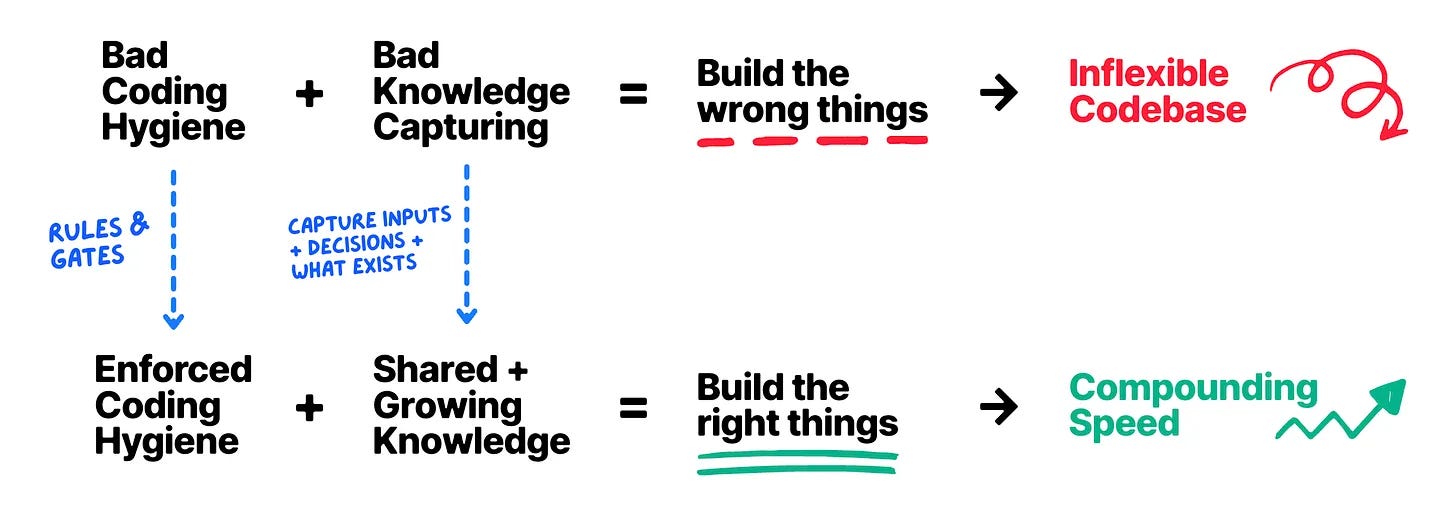
So docs become an asset that improves the development loop, instead of a tax. And the more context the team captures, the more coherent decisions the AI can make on the next project.
This is especially important for building the right thing, as opposed to simply the next thing. A codebase becomes easier to steer when future work can see past decisions.
Read the full article here 👇

🤝 Good engineering is an exercise in human relationships
Two years ago I had Kent Beck on the podcast, and we talked about Extreme Programming and TDD. I rewatched that interview recently to figure out what has changed (and what has not) since then, and a part that stuck with me is when he said good engineering is an exercise in human relationships.
This is easy to miss because you may just treat XP as a bag of techniques: short cycles, tests, pairing, reviews, and so on. But all of these only work if people communicate and give each other feedback.
This ties in with Kent’s idea that Agile goes largely against traditional power structures. Waterfall represents a fatal attraction for many teams because it replaces grassroots communication with a plan that gets transmitted down through hierarchy.
If the human relationships are missing, you can install the practices and still not have the actual engineering.
You can find the full conversation with Kent here 👇
📚 Weekly Readings
Finally, here are the best articles I have read this week:
🥇 The Kids Are Alright
6 min • by Francisco Trindade
Francisco takes on the question of whether we should still hire junior engineers, and his answer is a strong yes. If the job of a senior becomes leading a project by orchestrating agents, the job of a junior will be to lead simpler projects in the same way. And if juniors have nothing meaningful to do on your team, that probably says more about your process than about them. I loved this one.
🥈 Software Factories Are a Local Maximum
3 min • by Aviv Ben-Yosef
Aviv makes a great point: agents can make us lose the healthy friction that made us think about why we were building something. I have written a lot about software factories myself, and I 100% agree with him.
🥉 How to Write an Effective Software Design Doc
15 min • by Michael Lynch
Michael wrote design docs at Google and Microsoft, and this is his full playbook on when a doc is worth it, what belongs in it, and what doesn’t. I feel this is even more relevant today, since a good design doc is pretty much the context you want to give your agents (or have them help you write anyway).
And that’s it for today! If you are finding this newsletter valuable, subscribe to the full version!
1700+ engineers and managers have joined already, and they receive our flagship weekly long-form articles about how to ship faster and work better together! Learn more about the benefits of the paid plan here.
See you next week!
Luca