


Hey, Luca here! Welcome to a new 🔒 weekly essay 🔒 from Refactoring.
Every week I write an article to 170K+ engineers about how to make good software together. To get access to all our articles, resources, and our private community, subscribe to the full version.
I remember when an engineer friend of mine told me:
The pace of change is just unsustainable. Every week we are supposed to change the way we work.
But this was circa 2018, and he was talking about JS frameworks. Feel old yet? These were, apparently, the good old times!
Jokes aside, AI feels different from a new JS framework, and many engineers I talk to are struggling with it in a deeper way.
When our work is challenged, our identity is challenged, too. This is especially true for knowledge workers, and for engineers in particular: we find the output of our work to be an act of creation, and so we take pride in it. It’s easier for us to identify with what we do than it is for people who do less creative jobs, which means that changing how we work has very direct psychological consequences.
I know this because of my own weird journey. I studied CS, started a PhD, dropped out to start a startup, sold it, became director of a larger company, and today I run Refactoring and Tolaria: respectively a newsletter and an open-source app.
This means at different points in time I have been a researcher, a founder, a manager, a content creator, and an open-source maintainer. Many of which at the same time!
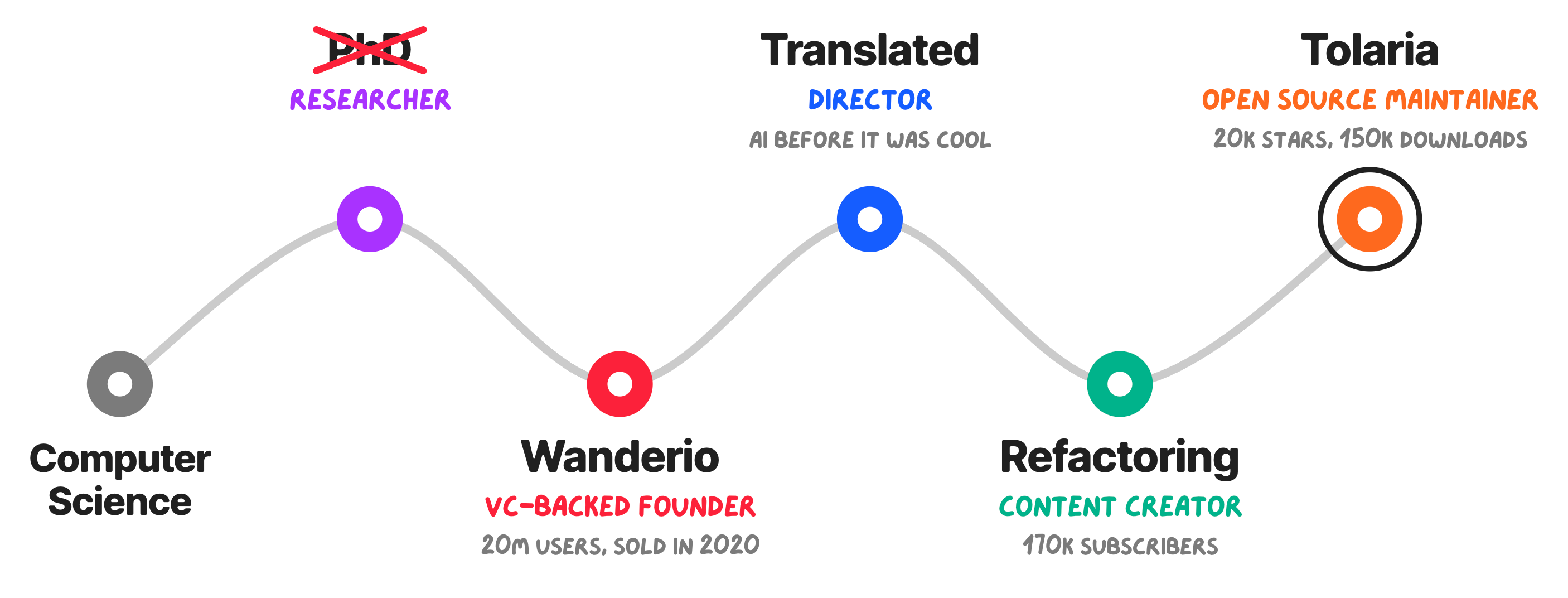
I don’t think I am exactly world-class at any of these, but I feel fortunate to having done many different things, and having looked at tech from different angles. But this also means along the way I had my own sense of identity challenged many times, and had to adjust. Every single time.
Sometimes change felt easier, other times harder, but it eventually became a familiar feeling. That’s probably today why I am not bothered too much by AI, but I understand why many people are.
So, today I want to talk about how you can think about all of this in order to become more resilient, both psychologically, and – practically speaking! – on the job market. I won’t make big predictions, because I don’t feel I am particularly good at those, and also because no one really knows what is going to happen anyway. Instead, I’ll share a few principles and mental models that work for me and I believe will stay true for a long time.
This is pretty much what Ray Dalio does in Principles: if you do ambitious things, you will go through struggles and fail at some of them, but if you pay attention, you can turn what you learn into principles that work for you. Dalio also says that there are no principles that work for everyone: you should find your own! What follows are some of my principles, not necessarily yours.
This is also a written version of the talk I am giving today at code.talks in Hamburg, and you can find the slides here.
Here is the agenda for today:
🥣 Be a mediocre soup — also how to walk on ice, and put dots on maps.
👔 Work as a manager — own the outcome, not necessarily the building.
🔀 Product or platform — the two directions you can broaden your role in.
🚌 How to make it happen — drive the change, and be slightly too ambitious.
📚 Resources — articles to dive deeper on each of these.
Let’s dive in!
🥣 Be a mediocre soup
One of my favorite ideas about personal identity comes from Scott Adams, the creator of Dilbert, who said about himself:
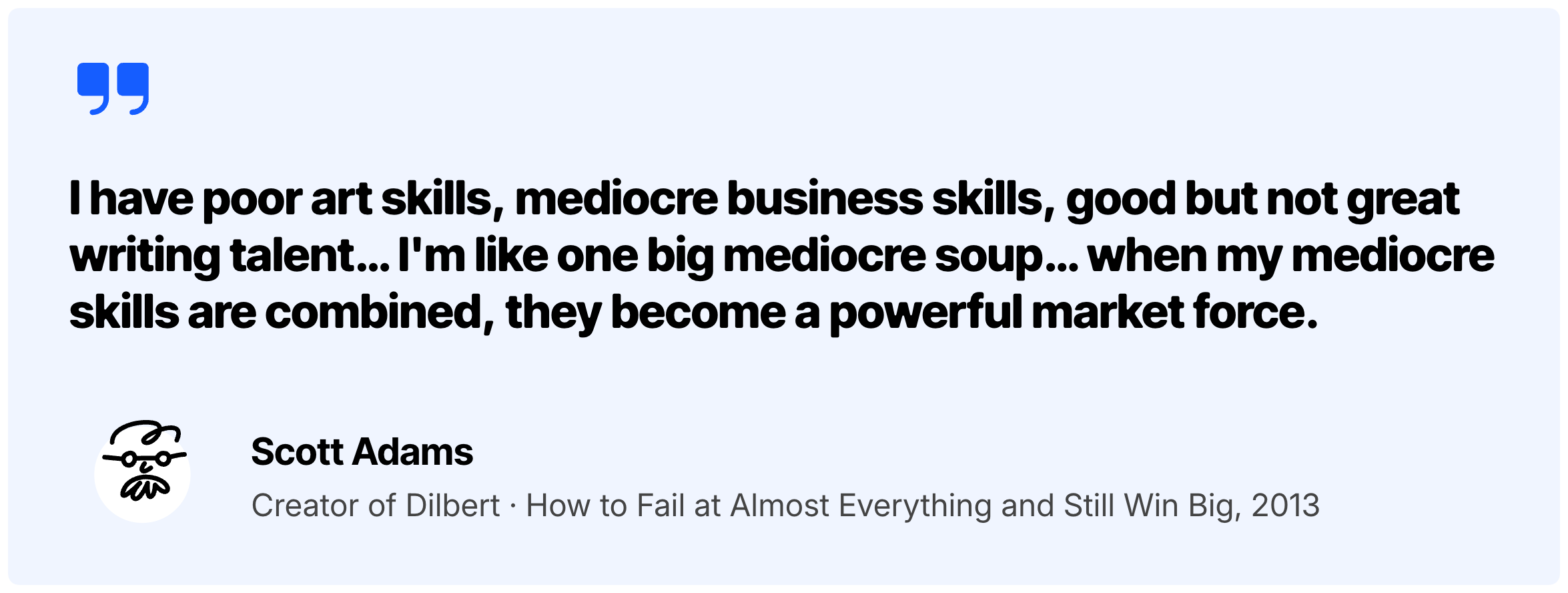
It’s not his skills that are unique, but rather their combination. That gives him a good answer to the question: why me? Why should I be the one doing Dilbert?
I believe it’s important, at work, to be in a position where you provide a unique, or rare, way of contributing. I also believe that, especially today, it is easier to do that by combining different things you know, as opposed to becoming 99-percentile at one specific thing.
So, quoting Scott, the first principle could be: be one big mediocre soup. But I’d rather turn it into something more actionable, which is: find a broader version of yourself.