


Hey, Luca here! Welcome to a new edition of the 💡 Monday Ideas 💡 — ideas and readings to start the week on the right foot.
I also publish an original essay every Wednesday. Here is the one from last week in case you missed it:

Sponsored by our friends at AWS!
Build data-driven apps with Databricks on AWS
AI-powered solutions require connecting data, embeddings, and model deployment, with governance that scales. Databricks Data Intelligence Platform brings it together on a lakehouse built on Amazon S3.

Combine that with native AWS integrations to:
Unified deployment: Connect data, embeddings, and model deployment — no separate governance tooling
AWS-native integration: Use Amazon Bedrock, Redshift, and SageMaker directly from Databricks
Zero procurement friction: Deploy via AWS Marketplace on your existing account
Try Databricks Data Intelligence Platform for free in AWS Marketplace!
Databricks
Try Databricks Data Intelligence Platform for free in AWS Marketplace
Get started in AWS Marketplace ›
About AWS Marketplace
Visit AWS Marketplace for help finding the best solutions for your use case and add new capabilities to your tech stack with your AWS account:
Tools are designed to plug in to your AWS workflows and integrate with your favorite AWS services
Evaluate fast with free trials and developer-tier pricing to support fast prototyping
Avoid upfront license fees and pay only for what you use, consolidating billing with your AWS account
A broad selection of tools across AI, data, observability, security and more can enhance how you build with AWS
🚥 Collaborate more, coordinate less
A while ago PostHog wrote a great piece called Collaboration sucks, and I want to nitpick on it a bit: I believe it’s not collaboration that sucks, it’s coordination.
What’s the difference?
Collaboration is when many people contribute to the same output.
Coordination is when, in order to do what I do, I need to take into account what other people do.
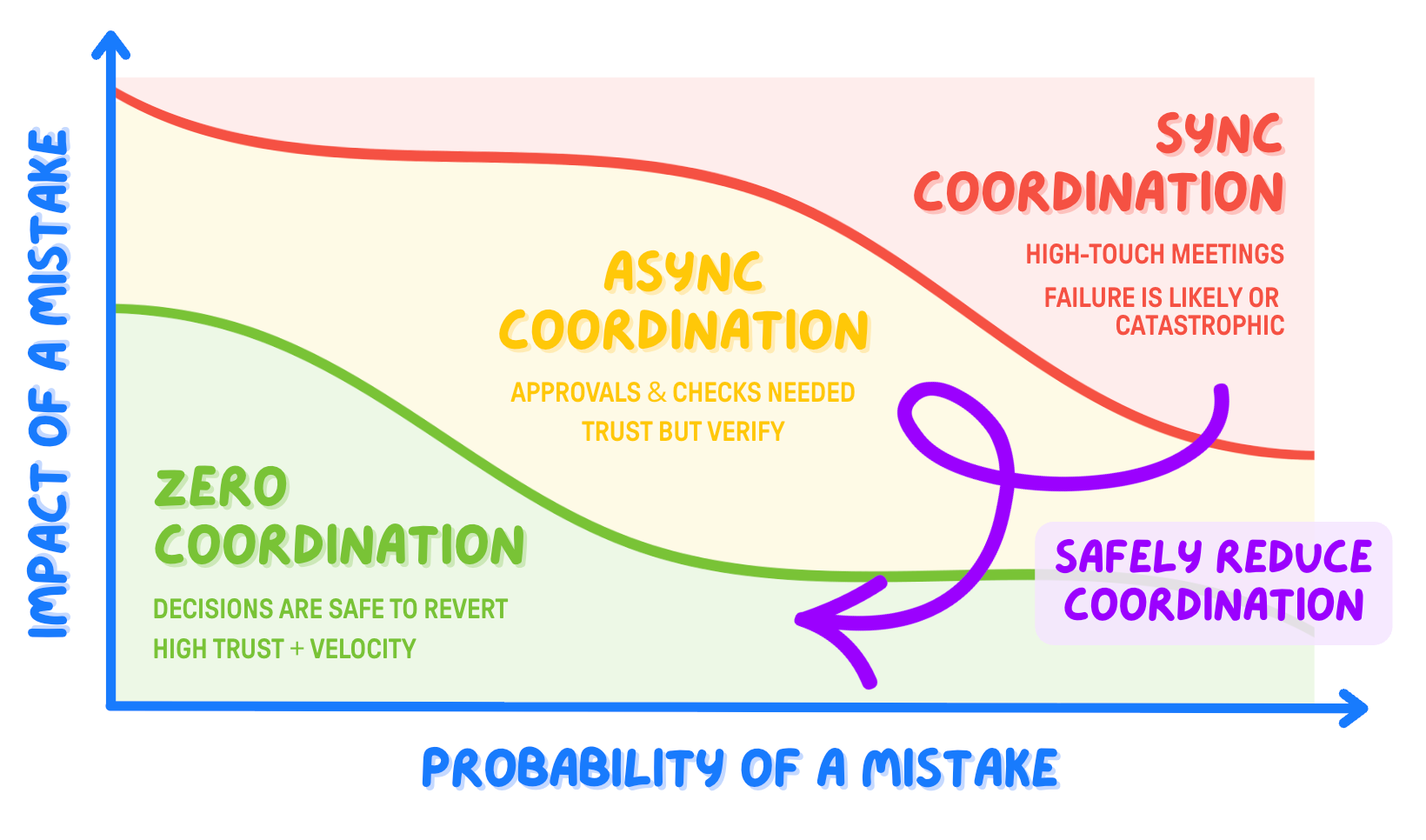
You can have a lot of collaboration with very little coordination, and it helps to think about coordination in three levels:
🔴 Sync coordination — we hold a meeting to make a decision.
🟡 Async coordination — I make a decision, but it needs to be approved before it is confirmed, and in the meantime I do something else.
🟢 No coordination — I make a decision and it doesn’t need anybody’s approval. It might get reverted if it’s wrong.
If you only look at throughput, these three are in ascending order of efficiency. In reality, to me picking the right mode depends on how likely a wrong decision is, and on how bad it would be for the product or the business.
So when you see coordination happening, it’s because the process believes that people, left to themselves, would make wrong calls too often, or that those calls would hurt too much. As long as these two factors are in check, you should always trend towards less coordination.
In my experience, most coordination comes from cognitive load: stuff is hard, people can’t fit everything into their heads, so we split the work into layers and specialties, and layers need coordination to get anything done. That’s also why I am bullish on AI letting people do more again, and merging some of those layers.
I wrote more about this, and about why AI productivity is so hard to pin down, in this piece 👇

🧠 Your sense of easy / hard is probably outdated
In May I talked with James Stanier, CTO at Nordhealth and author of several books about engineering management, and we bonded over a shared problem: our instincts about what’s hard and what’s easy are hard to keep up to date.
James describes an almost physical resistance to tackling certain problems, until he forces himself to try with AI and finds out that the barrier was imaginary. He points his tools at broad, messy problems, like “this area of the app seems slow, why?”, and gets actionable results, including shaving seconds off API endpoints.
To me, that resistance is muscle memory from a previous era of software, and if you let that old map decide what you attempt, you will end up underusing the new tools.
So you should make a habit of trying the things that still feel too big, too messy, or too vague. A lot of that feeling is left over from a world where you had to do everything by hand.
You can find the full conversation with James here 👇
📚 Weekly Readings
Finally, here are the best articles I have read this week:
🥇 The Conversation Before the Conversation
12 min • by Kevin Goldsmith
Kevin argues that the conversations leaders regret are not the hard ones, but the easy ones they postpone until the problem isn’t small anymore.
He also shares five signals that a conversation is already overdue, like people quietly working around the issue, or the talk in your head getting bigger every week. Loved this!
🥈 The CPTO role from people who know
6 min • by Anna Shipman
Anna shares notes from a panel of CPTOs, none of whom would go back to leading only product or only engineering. You don’t need both backgrounds, but you do need to find the challenge a peer used to give you.
It fits well with what I wrote this week about roles getting closer.
🥉 Introducing Review Box
4 min • by Radoslav Stankov
Rado built his own desktop app for reviewing pull requests, and did all of his 1,197 reviews this year in it. Agents write a lot of his code now, so he leaves bugs to AI reviewers and focuses on requirements and architecture. I love this take, and love when people build their own tools!
And that’s it for today! If you are finding this newsletter valuable, subscribe to the full version!
1700+ engineers and managers have joined already, and they receive our flagship weekly long-form articles about how to ship faster and work better together! Learn more about the benefits of the paid plan here.
I wish you a great week.
Sincerely 👋
Luca